Friday, July 12, 2024

An Aspiring Actress Tries to Survive More Than Just Show Business

Mia Goth in "MaXXXine"
Photo Credit: RottenTomatoes.com

In 2022, writer-director Ti West gave moviegoers not just the first installment, but also the second installment of his “X” trilogy with “X” and the prequel “Pearl.”  By doing so, he offered two of the best horror films of that year and made leading actress Mia Goth into one of the topmost performers to be working in the genre today.  Since the release of “Pearl,” audiences have been waiting to see how West would cap off his story of amateur actress Maxine Minx (Goth) trying to make it to the big time.

West finally presents his trilogy’s conclusion with “MaXXXine,” a thrilling finale that brings us to not just a new decade, but a new setting as we get pulled into a deadly journey with the titular character.

Maxine Minx is an adult-film actress who wishes to be taken seriously in the movie industry.  When she’s offered the lead in a horror film, Maxine uses this as a chance to prove herself.  However, when a serial killer known as “The Night Stalker’ begins terrorizing the streets of Hollywood, Maxine will have to do what she can to not become the next victim.

Goth provided excellent performances in “X” and “Pearl” that cemented her as one of cinema’s newest queens of horror, and she displays just as much command of the screen in this film.  Goth exhibits a duality of her character’s movie-star-wannabe confidence and a sense of someone who knows that she might be out of her depth.  Maxine has a masterful opening scene where she walks into an audition with a don’t-underestimate-me attitude as she tries to show that she’s more than people give her credit for.  However, this makes her scenes of trepidation on the sets of the horror movie all the more engaging because we see how much she has to lose, wanting to impress her director and knowing she has so few chances to do it.  Maxine knows how to fight for what she wants, but she doesn’t quite know how to fight to keep it once she has it, and that latter factor is fascinating to watch as Goth shows Maxine trying to develop into the person she wants to be.

The film has a terrific supporting cast, but the two standouts are Kevin Bacon and Elizabeth Debicki.  Bacon is a lot of fun to watch as a sleazy private investigator who worms his way into Maxine’s life and tries to derail her career.  He eats up the role as someone who won’t stop pursuing his target until his goals are met.  Meanwhile, Debicki is endlessly magnetic as the film director of Maxine’s latest project, an individual who demands perfection and takes Maxine under her wing.  Just like Goth, Debicki shows how her character is aware of how much her potential career is riding on her film production, and it’s fascinating to see her and Goth interact as their characters express the same vivid desire to become Hollywood underdog successes.

The screenplay by West has a bit of a pacing issue in the third act (we seem to simply arrive at the big reveal rather than build towards it), but it’s nevertheless a fun murder mystery that also dives into the controversy surrounding Hollywood in the 1980s when it came to violence and adult content in the media.  West shows it all in great detail as he crafts a narrative that has this Hollywood tension tie into Maxine’s past in intriguing ways as the danger on the show-business streets continues to close in on her, and this assists in adding layers to her character.  Just as West did with Maxine in “X” and the titular character in “Pearl,” he’s adept at letting us get to know the lead character in between the scares, making this a trilogy that’s every bit as much about building a character as it is about the frights.  All of this puts West’s horror-storytelling passion on display as we learn about Maxine both through her journey and through the company that she keeps and avoids.

The cinematography by Eliott Rockett (who lensed several of West’s films, including “X” and “Pearl”), masters the mood of the setting, particularly the lighting of the seedy establishments that the characters populate.  His camera movements capture the griminess of the environments, especially using lighting techniques that emphasize low lighting or red lighting that help us descend into the environment out of which Maxine needs to climb in order to live a better life.

As a director, West not only presents the details of 1980s Hollywood in dedicated detail, but he also crafts the movie to have its bloodier scenes have the look of an ‘80s horror movie.  To do so, he uses practical effects that exemplify a slasher movie gross-out factor that will make you squirm several times as the body count rises and the sense of dread increases with each scene.  Similar to the other two films in his trilogy, we get a full sense of West’s cinematic influences as he mixes them with his ideas to create a terrific blend of scares, period detail, atmosphere, and memorable performances.

For horror fans and general moviegoers, they should feel lucky to have seen West complete his story in his fullest vision.  This series had him leave his mark on modern horror, and with “MaXXXine,” he has the trilogy go out in style.

Grade: A-

Thursday, July 4, 2024

The Day That Silenced the World

Joseph Quinn and Lupita Nyong'o in
"A Quiet Place: Day One"
Photo Credit: RottenTomatoes.com

In writer-director John Krasinski’s 2021 film, “A Quiet Place: Part 2,” the terrific sequel to his original movie from three years before that, he gave one of the film’s best scenes with the opening sequence, a scene that takes place before the events of the first film.  In this scene, Krasinski delivered a pulse-pounding view into the first day of an invasion by aliens who hunt by sound as they descended upon the quiet town of his character’s family.  It couldn’t have been a better beginning to a film that would be on par with the frights of its predecessor.

We now get an even bigger view into the start of the invasion with the prequel, “A Quiet Place: Day One,” from writer-director Michael Sarnoski, in which he delivers a film of surprising emotional depth in between the scares and thrills.

The story follows Samira (Lupita Nyong’o) as she tries to traverse New York City when it descends into chaos following an alien invasion.

Nyong’o provides an endearing performance as a young woman who tries to cling to what’s left of her previous life.  Portraying a hospice patient caught in NYC during a day trip, she has her character muster every remaining bit of energy in her body to survive the apocalypse and return to her childhood neighborhood before her time runs out.  In between the scenes of running for cover, Nyong’o gives us memorable emotional scenes, and whether it be in scenes of no dialogue or with a little, she’s endlessly engaging to watch.  As you watch her go between processing the terror and reminiscing about what her life was like before she got sick, Nyong’o absorbs you in Samira’s arc as she not only as to survive the external threat of the aliens, but the internal threat of her illness, both of which collide to have her confront her mortality.

Nyong’o also has poignant chemistry with costar Joseph Quinn, who plays Eric, a law school student from England.  While they work well together in the sequences that hinge on their fight for survival, there’s a bittersweet scene in the third act that may be one of the best scenes this series has done.  All I’ll say is that it’s a poignant scene that does beautiful work with show-don’t-tell storytelling that allows these characters reveal small things about themselves.  These films show how much a blockbuster horror movie can thrive when you include some doses of human drama, and Nyong’o and Quinn have just as strong of an on-screen connection as the pairings of Krasinski and Blunt in the first film and Blunt and Cillian Murphy in the second.

Although the screenplay by Sarnoski is, in essence, more of the same as the first two films but just on a larger canvas, he makes up for the familiarity by making this the most emotionally impactful of the series.  In between the scenes of alien horror, he offers some wonderful dramatic scenes that really let us get to know Samira and Eric.  While we’ve seen characters in the past stay quiet for fear of being picked off by the aliens, Sarnoski uses this as an opportunity as a way to display who these characters were before the invasions as they try to open up to each other while still trying to remain as quiet as possible.

The cinematography by Pat Scola, who worked with Sarnosksi on his 2021 feature filmmaking debut for the revenge thriller, “Pig,” offers some imagery that goes between tenderness and somberness that allows for touches of the arthouse sensibility that we saw in Sarnoski’s previous film.  And, when it comes to the big set-pieces, Scola grants us imposing views of NYC besieged by otherworldly destruction, taking full advantage of the transition from the rural environments of the first two films to the cityscape offered by this one, capturing a sense of scale that shows the aftermath on a higher level.

As a director, Sarnoski proves that he’s every bit as capable to helm a blockbuster as much as an indie film.  Similar to “Pig,” he strikes a fine balance between effective drama and heart-pounding thrills.  Three movies in, and this series still exhibits that it can maintain its quality and thrive when it allows filmmakers to craft something that’s meaningful.  These movies are partially character-driven, with this film even more so, and Sarnoski is able to make the drama fit in just right with the surrounding sci-fi dread as he expands the overall story of the series.

Potentially, Krasinski’s coming back next year with a third film focused on the original batch of characters.  But, during that wait, it was fun to have an installment that shows someone else’s approach to the material.  With that, Sarnoski makes his voice heard in this quiet place.

Grade: A-

Saturday, June 1, 2024

Through Desolation and Disorder, the Makings of a Post-Apocalyptic Heroine

Anya Taylor-Joy in 
"Furiosa: A Mad Max Saga"
Photo Credit: Imdb.com

Nine years ago, director George Miller brought moviegoers back to the sun-scorched, brutal environments of the Wasteland with “Mad Max: Fury Road,” the fourth film in his “Mad Max” series.  With memorable characters, captivating visuals, and car-chases that left you exhausted in the best possible way, this became one of the best and most exhilarating action films of all time.  It was a brilliant, imaginative, and beyond epic return to the world of Max Rockatansky and malevolent marauders, and we couldn’t wait to see how Miller would expand the world further in the next installment.

And, expand it, he does.  However, he doesn’t do so by going forwards, but going backwards.  Now, Miller delves into the history of Furiosa, a character who was introduced in “Fury Road” and played by Charlize Theron.  In “Furiosa: A Mad Max Saga,” Miller gives us a detailed, ferocious, and action-packed look into how Furiosa became the resilient protagonist who fired up the screen in the previous film.

As a young girl, Furiosa (Alyla Browne) is kidnapped by the savage Biker Horde leader, Dementus (Chris Hemsworth).  When circumstances arise later on that bring her to the Citadel, a fortress ruled by Immortan Joe (Lachy Hulme), an older Furiosa (Anya Taylor-Joy) soon gains trust with her ruler and rises in his ranks, eventually bringing her on a path for revenge against Dementus.

I’ve never seen a performance from Taylor-Joy that I haven’t liked, so it’s wonderful to see a whole new side to her acting ability, portraying an action heroine who must face-off against a cruel and unforgiving world.  While Taylor-Joy doesn’t appear until about halfway through the movie, she makes up for the wait by coming out in full force during one of the film’s big action set-pieces.  She captivates you right away as an unwaveringly tough fighter who does what she can to survive.  And, with only a few dozen lines of dialogue, she not only captures the spirit of Theron’s Furiosa, but also even sounds more and more like her as the movie goes on.  This is a committed performance that we’ve come to expect from Taylor-Joy, further showing why she continues to impress since her debut in “The Witch” from 2016.

Alyla Browne does superb work when introducing us to Furiosa as a child, giving us a look at the type of person we know she’ll become later on in the film.  Brown shows her character as a girl of resourcefulness and quick thinking, having the audience know that, even when she’s in the most dire of scenarios, Furiosa will find a way to outsmart those who wish her harm.  Just like Taylor-Joy, Browne doesn’t have a lot of dialogue, but instead must rely on her facial expressions to let us know how she absorbs her new environments and how she views others.

Hemsworth gives an intimidating performance that allows him to break the mold left by his tenure as Thor in the Marvel Cinematic Universe.  Just like his terrific performance on 2013’s “Rush,” this is a character that reminds us what Hemsworth is able to do when given the chance to do something that breaks the norm of what we’ve seen him do for most of his career.  It’s work that has him carry a sadistic charisma that not only unsettles you, but also makes you laugh from time to time.  He’s very much in tune with the eccentric nature of this series, and he calibrates his performance into something that very much feels at home in the film’s universe.

In terms of the villains, we also get a return of the terrifying Immortan Joe, with Hulme taking up the mantle of the late Hugh Keays-Byrne, who portrayed the character in “Fury Road.”  Between the movements of his hulking body and a stone-hard stare, Hulme’s able to maintain the menacing nature of Immortan Joe that Keays-Byrne established.  He also presents a perfect opposite to Hemsworth’s antagonistic portrayal, whereby, in a scene between Immortan Joe and Dementus where the two are bargaining, you have the former’s disquieting watchfulness versus Dementus’ comical overconfidence.  It’s a great scene that displays an entertaining dichotomy of these two tyrannical characters.

The screenplay by Miller and Nico Lathouris, who were two of the writers on “Fury Road,” brings a detailed backstory to the breakout character of that film.  Although the narrative drags a little bit in the first hour, it’s still fascinating to watch the pieces fall into place that build up “Fury Road” and to see how Furiosa’s arc feeds into that film.  Between the time we spend with her both as a child and an adult, we get an engaging and thrilling view into one of the most notable characters to come out of modern action movies.  The narrative also spends enough time in each of the main locations of the film, the three fortresses of the Citadel (we actually get more time in here than we did in “Fury Road”), the Bullet Farm, and Gastown, the latter two of which are only briefly seen/mentioned in the previous film.  Through all of this, Miller and Lathouris strike a fine balance of introducing new aspects and fleshing out what we saw in “Fury Road.”

Even 45 years after the original film was released, it’s still impressive how well Miller’s able to build some epic action sequences.  His filmography is made up of some of the best car chases you’ll see on film, and he continues that tradition with “Furiosa.”  It’s clear that this is the type of filmmaking that Miller lives for, once again displaying an abundance of creativity not only when it comes to putting these action scenes together, but also in the visuals concerning the settings that he gives us.  To bring his vision to the screen, Miller recruits the help of cinematographer Simon Duggan, a first-timer to the franchise, just like John Seale was on “Fury Road.”  And, similar to Seale, Duggan shows the fullest capability of lensing Miller’s ideas and working with a scope that captures the daunting nature of the fortresses and the vehicular chaos of the car chases.  

Miller is a filmmaker who always works hard to deliver with this iconic series, and based on what he presents us in “Furiosa,” you’ll certainly want to take this latest chance to be a desert dweller.

Grade: A-

Saturday, May 25, 2024

A Stuntman Gets into Some Off-Camera Action

Ryan Gosling and Emily Blunt in 
"The Fall Guy"
Photo Credit: RottenTomatoes.com

For big-budget films, one of the most important aspects is having a committed stunt team.  They’re the ones who make the intricate movements of the characters possible.  As viewers, we sit there thinking to ourselves that there’s no way we could ever pull off such death-defying work, but when you see it up there on the screen being performed by people who stare danger in the face as soon the cameras roll, you’re left in awe that such feats have been captured.

The work of stunt teams is the basis of director David Leitch’s new comedy, “The Fall Guy,” which is based on Glen A. Larson’s TV show of the same name, which ran from 1981-1986.  With Leitch’s typical flair for action, he brings us on an energetic ride that’s loaded with thrills, wit, and a superb connection between its two stars.

Colt Seavers (Ryan Gosling) is a stuntman whose latest job has him working with his ex-girlfriend, Jody Moreno (Emily Blunt), who’s making a sci-fi action film as her directorial debut.  When the film’s lead actor, Tom Ryder (Aaron Taylor-Johnson) goes missing, Colt is tasked with finding him before the over-budget production gets shut down.

Gosling gives a humorous and kinetic performance as the talented stuntman, once again displaying his movie-star charm with ease as he swaggers his way through the memorable dialogue and big-budget set pieces.  Gosling displays a ruggedness and confidence that’s faultless throughout, giving us a protagonist who’s comically endearing.  His work in the past has shown that he possesses equal talents with action, comedy, and romance, and Gosling proves once again that he can pretty much shine in any kind of genre.

Gosling and Blunt have wonderful romantic and comedic chemistry.  Whenever they interact, they display a bond that’s both funny and heartfelt, giving you an idea of the loving relationship that they shared before the events of the movie.  Even when their characters are at odds with each other, Gosling and Blunt exhibit a connection that’s as fiery as the pyrotechnics on Jody’s movie set.

The screenplay by Drew Pierce does well in establishing the two lead characters and the bond that they used to have and are trying to rebuild.  He sets them up in such a way that makes you want to get to know them more, and he does this with some well-placed meta humor.  And, although that aspect of Pearce’s humor doesn’t always hit the mark, it still works well in other places.  One of the best examples of this is when he mixes meta humor that’s both verbal and visual during a phone conversation between Colt and Jody that uses the split-screen technique in a clever way that highlights their emotional distance from each other.  Besides the romance, there’s an enticing conspiracy plot that has plenty of excitement as you wait to see how it unfolds.  Each set piece that Pearce brings us delivers on the enjoyable insanity of the situation, terrifically melding a likable lead character with a comically dangerous scenario.

Leitch, who has extensive experience as a stuntman, is the perfect fit for a film such as this, creating a love letter to both stunt teams and moviemaking.  He frames his action with the help of lensing from Jonathan Sela and editing by Elísabet Ronaldsdóttir, both of whom have been frequent collaborators with Leitch.  With Sela’s lensing and Ronaldsdóttir’s editing, the action is captured in such a way where it maintains the thrills, but are still comprehensible when it comes to knowing where everything and everyone is and what’s going on.  While all of the action scenes are fun, one of the most memorable is a fight sequence in a neon-lit nightclub, complete with some humorously trippy visuals.  Through this talented trio, they also offer a couple of eye-catching long takes that highlight the depth of the details of the film sets.  These extended takes allow us to see all of the comings and goings of the people involved with the film production, bringing us into the hectic nature of such environments.

When it comes to “The Fall Guy,” you won’t need air conditioning in the theater because this movie is as breezy as it gets.

Grade: A-

Saturday, May 18, 2024

In the Future, Primates Lead the Animal Kingdom

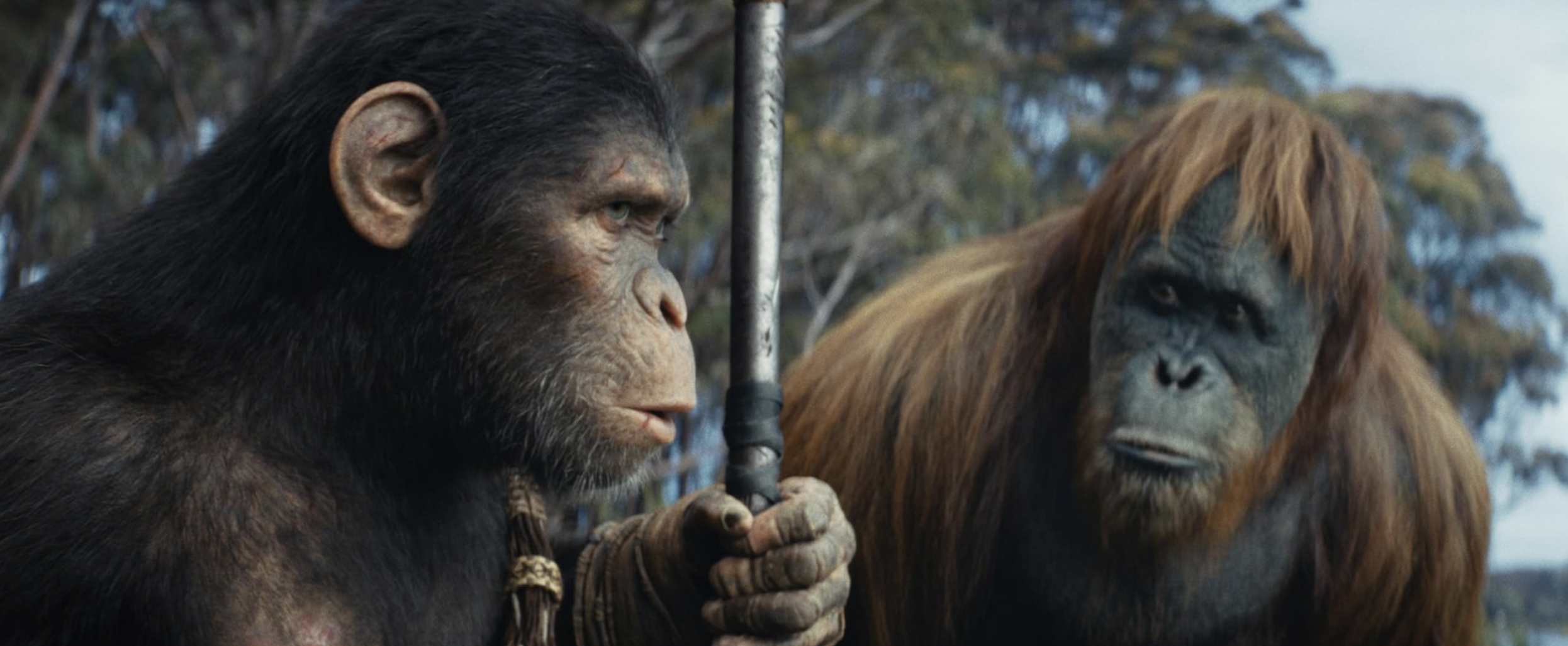
Noa (Owen Teague, left) and Raka (Peter Macon) 
in "Kingdom of the Planet of the Apes"
Photo Credit: Imdb.com

Nearly 13 years ago, the “Planet of the Apes” franchise was given new life in the form of a prequel with director Rupert Wyatt’s “Rise of the Planet of the Apes.”  In what seemed like just another attempt to revive the series after Tim Burton’s lackluster 2001 remake of the 1968 original, it nevertheless proved to be a thrilling and intelligent film that boasted some groundbreaking visual effects.  It began as the story of a highly intelligent chimpanzee named Caesar (through a motion-capture performance by Andy Serkis), only to then spawn two sequels from director Matt Reeves in 2014 and 2017, titled “Dawn of the Planet of the Apes” and “War for the Planet of the Apes.,” respectively.  With these three films, we were given one of the best trilogies of modern cinema.

It turns out this series still has some stories left to tell because we now have the latest installment, “Kingdom of the Planet of the Apes,” directed by Wes Ball.  With typically beautiful visual effects, emotional performances, and an epic scope, we have a great start to a whole new narrative within this decades-old series.

Several generations after the events of “War,” the story follows a young chimpanzee named Noa (Owen Teague), a hunter and heir to his ape clan.  When his community is attacked by an enemy clan and he’s left for dead, Noa teams up with a reclusive orangutan, Raka (Peter Macon), and a young woman, Mae (Freya Allen), to take on an ape society that’s ruled by a bonobo ape, Proximus Caesar (Kevin Durand).

Even though Serkis doesn't return as Caesar, Teague takes up the mantle in a strong performance as a young ape who comes of age by having to save his tribe.  Right from the beginning, Teague exhibits his character’s fun-loving nature mixed with an adolescent bravery as he swings and climbs through his environment, and we can sense that this is a character who could very well grow into a superb protagonist going forward.  Teague shows Noa’s attempt to grasp a world he has yet to understand as he ventures into it, having to come to terms with re-examining his beliefs when other people tell him differently and show his beliefs in a different light.

Macon gives a tender performance as Raka.  Just as Noa replaces Caesar, Raka fills in for the role of Maurice, an orangutan who befriended Caesar throughout the previous trilogy.  Macon brings across a low-key piousness as he displays someone whose beliefs remain unshaken in a changed world.  Throughout this, he also has touches of humor that offer some levity here and there as he imparts some wit and wisdom on to Noa.

When it comes to the main villain, Durand offers an intimidating presence as Proximus.  Durand exhibits the beastly formidability of a primate who leads his kingdom with a countenance that’s a mix of a king and a fervent religious leader.  It’s a performance where Durand inhabits the full commanding nature of his character, being able to render a space quiet whenever he has a word to give.

As the two humans at the center of the story, Allen and William H. Macy give fine performances that further emphasize the complicated nature between humans and apes, something that will come into play even further in future installments.

While the screenplay by Josh Friedman could’ve offered a little more time to the antagonist, he makes up for it by giving us details into Noa’s society and the loved ones he has in his life.  Between what we see in Noa’s community and the lands through which he travels, Friedman maintains the figurative presence of Caesar throughout, whether it be through dialogue or visual motifs.  With this, it’s fascinating to see how the world has been influenced by Caesar many, many years since his death.  We’re provided with a view into how his teachings have been followed to their true meanings with one ape clan, and how they’ve been twisted by another.  Through that aspect, the story touches upon religion and how certain people restructure their beliefs to fit their own desires.  Friedman manages this through moments that get the point across without it being heavy handed, adding to the thematic depth that has been maintained in the newer films.  By doing so, Friedman’s screenplay explores the outline and ideals of this world in a way that promises a compelling view into how this setting might unfold in later films.

Despite it being almost 13 years since the release of “Rise,” this series still leaves you in awe of what the special-effects team can accomplish.  Between the texture of the fur on the apes and the look of their environments, these effects look astonishingly real and continue to break barriers for what visual effects can do.  The effects immerse you in this world right from the opening scene, where you travel with Noa and his friends through forests and vegetation-laden buildings.  With this introduction, it’s evident that we’re in for a gorgeously realized journey.

The cinematography by Gyula Pados, who provided the camerawork for Ball’s second and third “Maze Runner” films, captures stunning views of the lands that nature has overtaken since the fall of civilization.  Pados’ lensing is meant for the big screen, providing eye-popping environments throughout, from the lush greenery of Noa’s home to Proximus’ seaside kingdom that’s composed of the rusted ruins of beached ships.  He captures every detail of the special effects, providing shots that have us marvel at the world that’s been created, a world that looks both beautiful and grim.

Ball, who up until this point only had experience directing young-adult fare with the three “Maze Runner” films, shows a new talent for thoughtful blockbuster filmmaking.  His work here exhibits a confidence in putting his stamp on this famed sci-fi series, displaying an ability to capture the scope of what has come before.  Between the way in which he handles the thrilling action set-pieces and the dramatic interactions amongst the characters, he maintains that balance the previous trilogy did so well, and it’s clear that he’s up to the task of ushering us into this enduring franchise’s new phase.

While Caesar’s story offered a captivating trilogy, “Kingdom of the Planet of the Apes” gives a reason for the franchise to continue beyond that.  If the care for the story and characters remains, we’re in for a further evolution of this series.

Grade: A-

Tuesday, May 7, 2024

A Love Triangle Has Tennis Players Caught in a Net of Romance

Mike Faist, Zendaya, and Josh O'Connor 
in "Challengers"
Photo Credit: RottenTomatoes.com

When it comes to tennis, it’s hard to imagine there’s anything else for the spectator, other than just sitting in the stands simply watching a ball go back and forth on the court.  However, there’s a little more to it than that.  With tennis, you’re watching a game of constant movement as the players hustle from front to back and side to side as they chase the ball to get another swing at it.  To be in that environment, the energy and tension is fun to experience.

Director Luca Guadagnino captures all of that and much more in his romantic sports drama, “Challengers.”  With a trio of spark-inducing leads, a complex and emotional narrative, and some exciting technical work, we have the latest sports movie that can appeal to both fans of the game and everyday moviegoers.

Tashi Duncan (Zendaya) is a talented tennis player who retires early after a knee injury.  Now, her tennis-playing husband Art (Mike Faist), is staging a comeback, with the help of her coaching.  As he makes his way through a series of matches to the final face-off, he realizes he’ll have to go up against his former best friend, Patrick (Josh O’Connor), who also happens to be Tashi’s former boyfriend.

Zendaya gives an electric performance as a tennis star who exudes a competitive persona.  She exhibits unshakable fierceness when she’s on the court, showing the audience how committed she is to her game and won’t let anything stand in her way to greatness.  In the scenes that show the dramatic side to her character, we see someone where it’s obvious that tennis has become the core of who she is, someone who expresses her romanticized view of the game when she first meets Art and Patrick.  When it comes to those two characters, Zendaya has great chemistry with them.  Whether she’s working with one or both of them in a scene, Zendaya shows an attitude that shakes up the screen as Tashi maneuvers through the affections and eventual relationships of her suitors.

I can’t get into deep detail about the performances of Faist and O’Connor without going into spoilers with their character arcs, but I’ll say that they have terrific competitive energy as two players who are pitted against each other.  Whenever they share the screen, you can see the evolution of what was once a great friendship that has now turned into something very damaged.  As the film goes on, you can sense the strain getting tighter and tighter around their bond as their athletic kinship slowly starts taking a backseat to fierce animosity when their mutual love for Tashi corrodes the connection that they’ve built.

The screenplay by Justin Kuritzkes utilizes a non-linear narrative as an intriguing method to let us know the history behind these characters.  The way in which this story goes back and forth through time gives it the feeling of a tennis match as your attention is pulled between different moments of these characters’ lives.  This keeps us immersed throughout the film as we watch certain scenes play out, and then go back in time to see why such things happened the way they did.  This adds a depth to the frame story of the game between Art and Patrick, with Tashi sitting with the spectators and acting as the audience surrogate as she and the viewers watch the two former friends and analyze where it all went wrong.  The narrative offers plenty of time to set up the dramatic stakes, having us get to know the three characters who are involved in the love triangle, as well as how the relationships, both platonic and romantic, are created and dismantled as we get closer to the big match.

One of the strong points of the screenplay is how Kuritzkes uses many small details that appear and then return later on.  Not only do the multiple appearances of these details add layers to the narrative on a thematic level, but they also show how times have changed the characters.  These details take on bigger meanings when they pop up again, encouraging you to compare the first time and second time that they appear and what they all stand for in the greater scope of the story.

The cinematography by Sayombhu Mukdeeprom provides standout camerawork that adds to the tension both inside and outside of the tennis sequences.  He provides some excellent long takes, be they dramatically tense encounters or scenes on the court.  These scenes allow for the fullest emotion of the characters to unfold as their situations become more and more complicated, and the audience will watch a scene evolve from one thing into something else entirely.  One of the most memorable instances of Mukdeeprom’s cinematography comes near the end of the final match between Art and Patrick, when the camera shifts to the POV of the tennis ball as it continues to get hit across the court.  In a scene that’s already overflowing with energy, this brings some extra visual flair to the sequence as the match reaches a boiling point.

The editing by Marco Costa transitions between timelines with an abundance of ease.  Costa juggles several time periods in such a way that doesn’t lose the audience, but instead keeps us invested in the layers that are constantly being pulled back as we’re brought further into the past events that lead up to the frame story.

The score by Trent Reznor and Atticus Ross, as usual, comes loaded with a techno vibrancy that gets your blood pumping as you watch the tennis matches and the confrontations between the main characters.  Just like with the camerawork and editing, their music makes sure that the tension doesn’t abate when we’re off the tennis court, but continues as the trio of characters sorts through the difficulties that their relationships face when their competitiveness spirals out of control.

This is a movie that comes with an equal amount of drama and laughs.  Just as the editing does well with its switches between timelines, Guadagnino has an expert dexterity when going between the humor and emotion, the seriousness and witty awkwardness.  It’s a whirlwind of tones that Guadagnino is able to keep under control as he brings us through the increasing chaos of the personal and professional lives of the three main characters.  Even though this is a romantic drama at heart, Guadagnino certainly knows how to mix in some great sports action that will absorb the viewers into the game, staging it with a fine eye for movement that’ll make your heart race as the aggressiveness of the players grows with each serve.

For “Challengers,” Guadagnino has assembled a talented group that presents us a movie that’s about more than tennis.  He combines the abilities of the writer, actors, and technical crew to give us a romance-based sports film where you feel the weight of everything that’s being said and done to the characters.  Once the movie is over, you’ll see there isn’t anything that’s not left on the court.

Grade: A

Monday, April 1, 2024

The Darkest Night in Late-Night TV

David Dastmalchian in
"Late Night with the Devil"
Photo Credit: RottenTomatoes.com

Throughout the decades, movies have come out with some thought-provoking stories about television that show the effects such a medium can have on people, be they the viewers or those who are viewed.  One of the best movies to do this is Sidney Lumet’s masterpiece, “Network.”  However, we’ve also had brilliant TV-centric stories in movies like Robert Redford’s “Quiz Show,” Peter Weir’s “The Truman Show,” and David Cronenberg’s “Videodrome.”  Through these movies, we’ve had fascinating instances of one medium analyzing another, and to great effect in all of these cases.

Writers-directors Colin and Cameron Cairnes bring us their own look at television with the found-footage film, “Late Night with the Devil.”  Boasting a terrific lead performance, spooky visuals, and an unshakable atmosphere of dread, it all shows that there’s still life for the found-footage sub-genre within the bigger world of horror.

On Halloween night in 1977, Jack Delroy (David Dastmalchian), a once-popular talk-show host who’s experiencing a decline in ratings, decides to invite a possessed girl onto his show to gain more viewers.  What happens during the recording is a phenomenon that no one can explain.

Dastmalchian has impressed audiences in memorable supporting performances, but he now has a leading role where he can really show off his talents.  He pulls you in with talk-show-host excitement, but also has you wonder what’s lurking beneath his lights-and-cameras façade.  He inhabits the role of someone who’s humble at first to be in the spotlight, but will then do whatever he can for higher ratings.  As the film goes on, that character transition has Dastmalchian show someone who exhibits a hunger for survival in the late-night landscape, even though the survival for those around him is at risk.  It’s the type of performance where, despite being understated throughout, we really see the kind of person that this character is, and it speaks to the accomplished acting abilities that Dastmalchian has displayed over the years.

The supporting cast does a superb job in contributing to the unsettling atmosphere of the film.  There’s Laura Gordon as a parapsychologist and author; Fayssal Bazzi as a psychic; Rhys Auteri as Jack’s talk-show sidekick; and Josh Quong Tart as the show’s producer.  However, the two standouts are Ian Bliss as a magician turned skeptic and Ingrid Torelli as a young woman who’s possessed by the devil.  Bliss is a lot of fun to watch as a pompous individual who’ll do whatever he can to prove himself right in his supernatural doubts.  Seeing him butt heads with those around him has humor to it, but also plenty of tension as you remain on edge to see where this will all go.  Meanwhile, Torelli is very unsettling when portraying her character, speaking with an innocent tone of voice that hints at it just being an act put on by the evil lurking beneath, all while looking into the camera with a chilling, vacant stare.  With this, Torelli perfectly conveys a possessed individual without overplaying it.

The screenplay by the Cairnes duo goes back and forth from the on-air footage and the behind-the-scenes hustle and bustle during the commercial breaks, giving us a full view of what the audience sees and the damage control that takes place in the background as things get more and more out of hand.  However, before we get to that, the narrative provides a documentary-like prologue that gives us an idea of who Jack Delroy is as a TV star and who he is in his private life.  All of this is an enticing setup that offers a look into the type of person he might be and keeps you guessing as to how certain aspects of his troubled past will play a role in the present.  The film offers plenty for each character to do, with the story providing many tense interactions between them that grow into something more as the film goes on.  Throughout all of this, we’re presented with a disquieting look into the heart of the main character and what people are willing to exploit in order to get what they want.

As directors, the Cairnes show a terrific eye for detail in recreating the ‘70s talk-show setting, in both the art direction and costume design.  It all gives you a sense of watching TV during this era and seeing the chaos unfold.  Aside from visual effects that joyfully call to mind the low-budget wizardry of sci-fi and horror films from that decade, this movie also utilizes memorable practical effects in certain instances, helping to highlight the hand-made movie magic of the decade in which this film takes place.  Even though it may be easy to dismiss the found-footage aesthetic as being overdone after the last 15 years gave us many such films, this filmmaking duo keeps things fresh by not only offering a strong sense of time and place, but also by getting very believable performances out of their cast, performances that make you feel like you’re watching an authentic broadcasting at times.

It’s been eight years since the Cairnes brothers’ last movie, “Scare Campaign,” was released, and we hopefully won’t have to wait that long for their next film.  But, without a doubt, I’m sure audiences will stay tuned after the break.

Grade: A