Tuesday, July 9, 2019

A Summer Getaway Turns Into a Nightmare

Jack Reynor and Florence Pugh in "Midsommar"
Photo Credit: Imdb.com
Last year, writer-director Ari Aster not only delivered the best horror movie of the year, but one of the best movies of the year with his feature directorial debut, “Hereditary.”  With the talent he was able to assemble in front of and behind the camera, Aster made a grand and unforgettable entrance with a film that was impossible to forget once it ended.  The horror genre found one of its next great visionaries, and it was just a matter of time before he returned for his second feature.

His latest endeavor, a folk-horror film called “Midsommar,” further establishes him as a master of horror, despite this only being his second full-length feature.  Here, he creates a scary, hallucinatory experience that offers a lot to unpack once it’s over.

Dani Ardor (Florence Pugh) is dealing with a family tragedy, which puts a strain on her already-rocky relationship with her boyfriend, Christian (Jack Reynor).  When he and his friends, Josh (William Jackson Harper), Pelle (Vilhelm Blomgren), and Mark (Will Poulter), decide to take a take a trip to a commune in Sweden for its midsummer celebration, which takes place every 90 years, Christian invites Dani after she finds out about it.  While their hosts seem pleasant at first, the days that follow will reveal the deeper and disturbing truths behind the festivities.

Pugh provides a visceral performance as a young woman overcome with grief.  Right from the beginning, her character is dealing with family issues, and Pugh delivers the emotional burden of her scenario, even when it has to be understated when trying to shield her troubles from Christian.  There’s a sense of loneliness that Pugh exhibits as her character remains distant from Christian and his friends, bringing us into the storm clouds wrapped around her head as she tries to acclimate herself into the group, but still feels a disconnection.  As you see Dani interact with the commune throughout the movie, Pugh portrays her character in such a way that keeps us guessing as to where she will be, psychologically, at the conclusion of the film, which is the main factor that grips you throughout this journey of increasing dread.

Just like with “Hereditary,” Aster’s screenplay focuses on his main character who’s buried in sorrow.  However, the circumstances of the plot allow for him to approach the subject from a different angle.  It explores Dani’s psyche as she seems to descend further down a black hole of madness, inviting you to see how this new and strange environment will impact her mental state the longer she stays there. 

With nearly a two-and-a-half-hour runtime, this movie has a lot of ground to cover, both before and during the trip in Sweden.  Plenty of time is spent in the beginning of the story to allow us to get to know Dani, the questionable relationship between her and Christian, and how she attempts to interact with others who see her as a burden.  All of this helps you become invested in her wellbeing and sympathize with her when no one else seems like they will.

Once we arrive at the commune, we’re given a full view into the traditions of its inhabitants.  While the hosts seem harmless at the beginning, Aster soon throws us into the upsetting reality of the meaning behind them and their customs, and we’re left wondering what sinister motives will be revealed as the film goes on.  Aster creates a community that’s fully realized in the narrative, providing an endless stream of details as we’re introduced to more and more facets of the commune’s lifestyle.

Aster re-teams with his “Hereditary” cinematographer, Pawel Pogorzelski, to switch from the terrifying use of darkness in that film to utilizing excessive summer sunlight to emphasize the details of the commune and show that the dangers of this community are present under the false protection of day.

The camerawork takes on a wavy quality in certain scenes that provide a psychedelic effect and make you feel trapped within the disorienting environment of the commune, making it seem like you can’t escape the hold that the inhabitants have on their visitors.  These sequences give you a disquieting sensation of being imprisoned in an unstable state of mind, lost in your surroundings, and not knowing what will happen to you.

In the first half hour of the film, Pogorzelski’s camerawork has a couple of instances of mirrors being used during conversations.  The first is where Dani is talking with Christian, where we see her actual self and a reflection of Christian in a mirror next her.  The second is where Dani visits Christian and his friends in one of their homes, and we see Dani’s reflection in a mirror and Christian and his friends’ actual selves as they’re talking with her.  It’s an effective way to highlight the detachment between them and Dani, furthering our realization of how isolated she feels when she’s among them.

The production design by Henrik Svensson focuses a lot on paintings, whether they’re those that are hanging on the walls of Dani’s apartment, or wall paintings at the commune.  It’s important for the viewer to pay attention to these paintings because they leave many clues as to what will happen in the film.  These are pieces to a complicated puzzle that have a storybook quality to their designs, but hold mysterious and disturbing implications.

Even with a lengthily runtime, Aster shows an ability to have every scene feel necessary, and he knows that this story needs enough time to have us absorb all of the details of the characters and commune.  Through it all, he continues to show a stunning talent for using his cast, camerawork, editing, set design, and sound to maximum effect and delivers another uncompromising vision of horror and raw emotion.

With just two feature-length films, Aster proves that he’s someone who can enliven the horror genre with something that will leave you shaken, and if his next movie is anything like “Midsommar” and “Hereditary,” it’ll be something that you won’t want to miss.

Grade: A

Monday, July 1, 2019

Top Five Films of 2019, So Far

John Chester and Emma the Pig in "The Biggest Little Farm"
Photo Credit: Imdb.com
5) The Biggest Little Farm - We’ve had a few great documentaries in the first half of 2019, and director John Chester’s reach-for-your-dreams account of him and his wife, Molly, building a farm out of a desolate piece of land is an absolute joy.  Chester provides a thorough look into how the farm came to be, the science behind its many aspects, and the ingenious ways in which he, Molly, and their team address the problems that arise.  The gorgeous camerawork highlights the countless details of the inner workings of the farm, both technical and biological, and to see the farm evolve over time from emptiness to lushness is to witness a vision come true for Chester and Molly.  There’s a sense of wonder in this movie that’s made even more potent because you see the rewards of the persistence in bringing the farm to life, and it’s an inspiration to viewers to go out and pursue their aspirations because this film shows that anything is possible when you set your mind to something.  When you watch this movie, you’ll realize that you’ve never seen a farm quite like this one.

Taron Egerton in "Rocketman"
Photo Credit: Imdb.com
4) Rocketman - While biopics about musicians tend to feel identical to each other, director Dexter Fletcher’s exuberant film about Elton John transcends the conventional, just like its subject, to bring us a rollicking and emotional view into the life of the iconic singer.  Taron Egerton solidifies himself as a bonafide star in the lead role, doing his own singing and transitioning into the role as he leaves it all out there on the screen.  The boldest move of this film is how it succeeds as both an in-depth examination of Elton and a full-fledged musical, staging several of his numbers as song-and-dance sequences, with one of the most notable being “Saturday Night’s Alright for Fighting,” a sequence whose energy offers pure excitement.  There’s vibrancy and drama to spare as we explore Elton’s success and demons, and thanks to all involved, this film is a tribute to the enthusiasm that Elton presented to his audience, making this a movie that his fame and genius deserve.

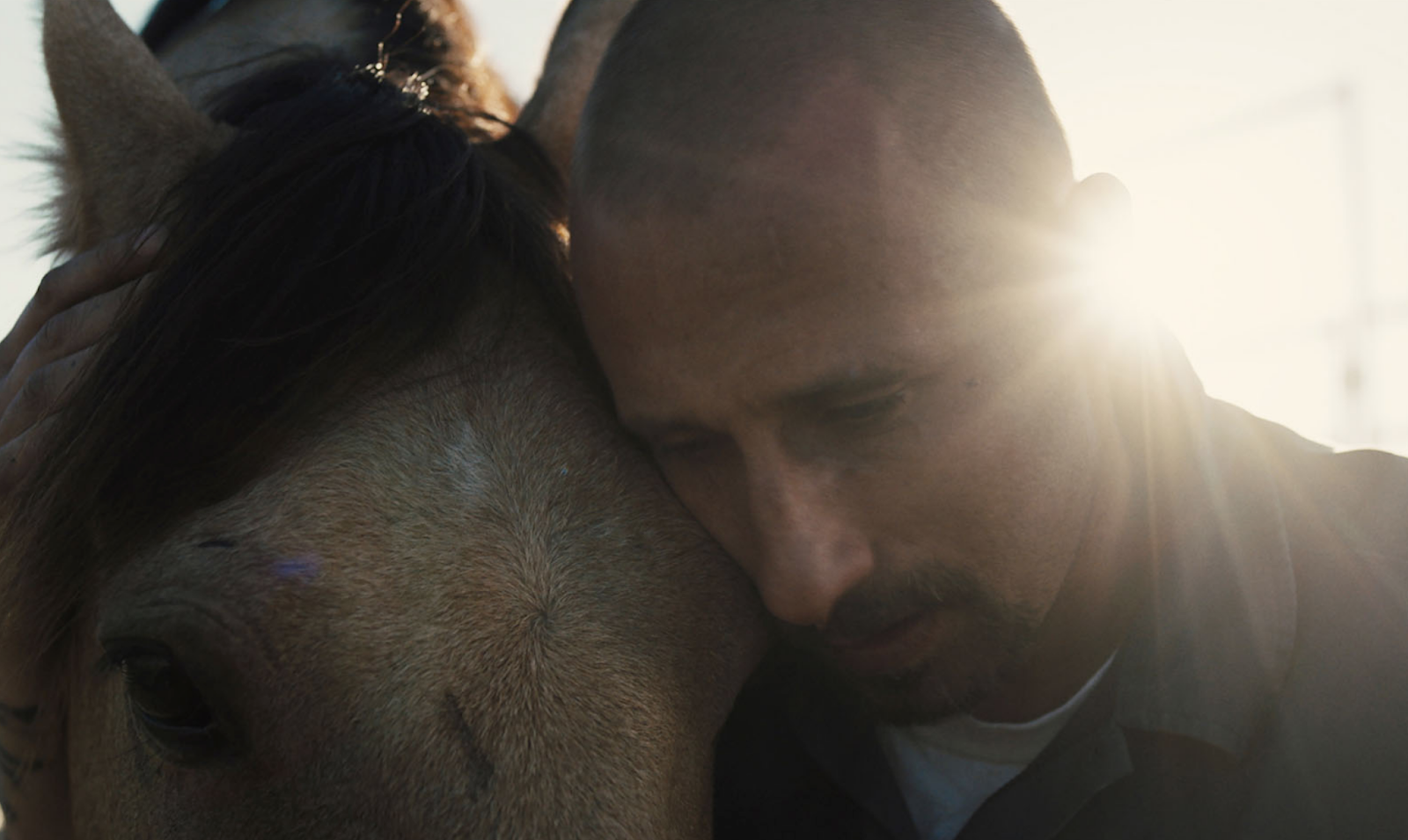
Matthias Schoenaerts in "The Mustang"
Photo Credit: Imdb.com
3) The Mustang - While this drama from director Laure de Clermont-Tonnerre may seem like your typical man-befriends-animal narrative on the surface, this film has more going on than it will have you believe.  The story follows Roman Coleman (Matthias Schoenaerts), a prisoner in a correctional facility, who’s given a chance at rehabilitation by taking part in a program where inmates train wild horses.  Schoenaerts delivers an understated, yet raw performance as the taciturn prisoner who doesn’t see any hope for himself, until be begins bonding with his horse.  This is a tender and emotional story of redemption that never feels the need to over-sentimentalize anything, knowing full well that great acting and subtle storytelling is more than enough to pull you into something that’s on this small of a scale, but leaves a huge impact. 

Lupita Nyong'o in "Us"
Photo Credit: Imdb.com
2) Us - After Jordan Peele impressed audiences with his directorial debut in “Get Out,” he has continued to build his stature as a top-tier filmmaker with his second feature, where he tells the story of a family who goes on vacation to their lake house, only to be confronted one night by a family that looks just like them.  Lupita Nyong’o gives a shattering performance as the matriarch of the family and her chill-inducing doppelgänger, bringing an intensity that’s in sync with the craziness that unfolds.  Having seen this movie twice, you have to marvel at how Peele allows you to pick up so many small details upon additional viewings, just as he accomplished with “Get Out.”  He shows an ability to move between low-key horror and in-your-face horror, while still imbuing the viewer with an abundance of clues that prove his talent for making us search for things upon revisiting the movie, things that might not be so obvious the first time around.  Peele is a filmmaker who can entertain, frighten, and make us think, and I’m sure he has other film ideas in mind that will do the same.

Honor Swinton Byrne and Tom Burke in "The Souvenir"
Photo Credit: Imdb.com
1) The Souvenir - Written and directed by Joanna Hogg, this romantic-drama unfolds a little bit at a time as it explores the relationship at its center, in a story about an aspiring filmmaker, Julie (Honor Swinton Byrne, daughter of Tilda Swinton), who falls in love with an enigmatic man, Anthony (Tom Burke).  Byrne gives a terrific breakout performance as a young woman who’s working towards her artistic ambitions, while also trying to find out the secrets to Burke’s character, and Burke is just as great as an individual who’s near unreadable at the start, but then begins to unveil himself.  This is one of those movies where you’re not sure where it’s heading, and this makes us pay extra close attention to what happens.  It’s romantic, mysterious, and engrossing, with Hogg’s achievement in establishing mood inviting us into the lives of these characters as we wait to see what becomes of the couple’s relationship.  By the time that the movie ends, there’s so much left to decipher, which makes this film an enthralling experience as you keep working to piece the mystery together as you leave the theater.  This movie doesn’t offer many answers at first, but if you think hard enough, you’ll find them.

When Zombies Rise in a Small Town, They Don’t Only Crave Humans

From left: Adam Driver, Chloë Sevigny, and Bill Murray in
"The Dead Don't Die"
Photo Credit: Imdb.com
The zombie sub-genre of horror has shown to be full of possibilities.  Not only is it capable of offering tense drama and scares, such as in movies like George A. Romero’s “Night of the Living Dead” and Dawn of Dead,” as well as in Frank Darabont’s hit television series, “The Walking Dead,” it has also proven to present the undead from a comedic angle, such as in films like Edgar Wright’s “Shaun of the Dead,” Ruben Fleischer’s “Zombieland,” and Jonathan Levine’s “Warm Bodies.”  These movies show that the apocalypse doesn’t always have to be a dour affair and can offer many laughs.

Indie filmmaker Jim Jarmusch tries his hand at a zombie comedy with “The Dead Don’t Die,” a movie that’s entertaining, thought-provoking, and proud to be odd.

In the quiet, small town of Centerville, the local police force (Bill Murray, Adam Driver, and Chloë Sevigny) tasks themselves with defending their community when a horde of zombies takes over.

The cast comes loaded with talent.  Besides Murray, Driver and Sevigny, the movie also has performances by Steve Buscemi, Danny Glover, Caleb Landry Jones, Rosie Perez, Carol Kane, Tom Waits, and Selena Gomez.  The story has to juggle many characters, so it might seem like there’s not much to the characters because of how little time many of them have for development.  However, this works for the movie because the characters being simply drawn reflects the small-town ordinariness of their lives; they’re just normal people going about their normal lives.

Out of all of these cast members, there’s one who’s given a little more with which to work, and that’s Tilda Swinton, who plays a sword-wielding undertaker, which should be enough to make you want to see this movie.  It’s an enjoyable and strange performance that brings out the magnetism that you feel whenever Swinton is on screen, whether it be in this film, or any other in which she appears.  Swinton doesn’t get a lot of screen time, but when she’s given a scene, you can’t get enough of her.

Despite the film ending the story-lines for each character in one way or another, there’s a trio of characters from a local juvenile detention center that the movie follows for a few scenes, but they aren’t given a resolution, which is a bit disappointing because there seemed to be potential in this plot thread.

The screenplay by Jarmusch doesn’t only supply laughs, but also some social commentary.  The film deals with the topic of complacency, with the characters carrying out their everyday lifestyles without any change, bits of dialogue being repeated throughout the movie, and zombies wanting to revert back to their routines by searching for things that they desired when they were human.  The film also explores the subject of ignorance as we hear some people on the news choosing to ignore the possibility of an apocalyptic threat, even though the evidence is there to support it.  There’s also some meta-humor that reinforces these concepts.  Although some of the commentary is a bit hammered in during the closing minutes, what comes before offers an intriguing angle from which to approach zombie films.

As a director, Jarmusch is able to maintain a comedically dry tone, while also providing tinges of dread from time to time, without it feeling too jarring.  And, once it comes time for the characters to take on the zombies, you have some fun action with Murray and his police force blasting rounds and swinging a machete into the undead, as well as Swinton having a good time slashing through her enemies with her sword.

“The Dead Don’t Die” may have a couple of flaws, but it still proves to be a zombie movie with enough bite to it.

Grade: B+

Tuesday, June 25, 2019

Between Playtime, a Group of Toys Has More Transitions to Face

Woody (voiced by Tom Hanks) and Forky (voiced by
Tony Hale) in "Toy Story 4"
Photo Credit: RottenTomatoes.com
In 2010, Disney and Pixar brought audiences the much-anticipated “Toy Story 3,” a film that concluded the storyline of Andy and his toys, including Woody (Tom Hanks) and Buzz Lightyear (Tim Allen), with a satisfying finale that couldn’t have been more perfect.  Because of this, it was impossible to think that anymore movies would be made in this series.  So, when “Toy Story 4” was announced four years later, it was difficult not to think that this would be more than an unjustified cash grab.

To my pleasant surprise, this fourth installment, directed by Josh Cooley (his feature directorial debut), is much more than what I thought it would be, delivering a clever, funny, and emotional continuation that’s on par with what came before.

Two years after the events of the third movie, the toys’ new owner, Bonnie (Madeleine McGraw), and her parents (Lori Alan and Jay Hernandez) take a road trip before she begins kindergarten.  When a new toy that she made, Forky (Tony Hale), and Woody become lost, they go on an adventure that will give them new insights into their lives as toys.

The characters that we’ve come to know over the last three movies make a welcome return, but it’s Woody and Buzz who continue to make these movies what they are.  The voice work from Hanks and Allen is a terrific as ever, building upon the friendship between their characters that established the foundation for this series.  However, of these two, it’s Woody who’s front and center for this installment, embarking on a journey that forces him to confront his purpose and has him make some of the toughest decisions his character has ever made.  Woody’s story has all been leading up to this, helping to make this a film that you might not have thought was needed, but has a special place in this series.

As with the other two sequels, this one does a superb job with introducing memorable new characters.  There’s Hale as the hilarious Forky, a plastic fork with googly eyes and pipe-cleaner arms; comedy duo Keegan-Michael Key and Jordan Peele as Ducky and Bunny, respectively, two stuffed animals with endless witty banter; Christina Hendricks as Gabby Gabby, a 1950s pullstring doll with some heartbreak in her life; and Keanu Reeves as Duke Caboom, a daring stuntman who always aims to impress.

The story also brings back Bo Peep (Annie Potts, who voiced the character in the first and second films), a porcelain figurine who was said in the third movie to have been given away, has a prominent role in the story.  Although she’s not a new character, the transformation that we see in her makes her feel like a fresh and exciting addition.  With these new characters mixed in with the returning ones, it’s clear that this series hasn’t lost it’s ability to juggle dozens of characters and have each of them be memorable in some way.

The screenplay by Stephany Folsom and Andrew Stanton manages the impossible and somehow create a narrative that’s able to continue to adventures of these toys that we’ve loved for years.  Throughout the other three movies, the toys are confronted with various issues in which they much confront themselves and think about what it means to live as a toy, and this film succeeds in providing another angle from which to explore the directions in which their existences as toys are taking them.  Just like in the other installments, this film focuses on the connection that children feel when they become attached to a toy, something that can provide them with emotional support in a time of uncertainty, which is highlighted in a scene near the beginning of the film where Bonnie creates Forky during her kindergarten orientation.  This also sheds light on a child’s imagination of not just taking an ordinary toy and playing with it, but creating something on their own and giving it its identity and purpose, which is something that Woody and Forky explore within themselves during the movie.  The last three films had insightful themes running through them, and it’s terrific to see that this installment does so as well, especially when it didn’t seem like there was anywhere else for this series to go after the third movie ended.

Cooley treats audiences to the best animation that this series has seen.  It’s remarkable to think how far the animation has come ever since the first film was released in 1995.  There’s a beauty to everything that you see within the designs of the toys and the places where the narrative takes them, and we witness how the animation has evolved every bit as much as the characters and story.

The other three “Toy Story” movies have offered flawless blends of comedy and emotion, and Cooley makes sure not to make this installment any different.  This movie will have you cracking up at one scene and then becoming misty-eyed in the next because Cooley knows that there’s so much to the arcs of these characters in which we become invested, and having us experience multiple emotions throughout the movie is one of the main reasons why these films are as good as they are.  These films have a lot to give us in terms of story and characters, which causes us to always move between laughs and tears and have a cherished moviegoing experience.

As much as I love this series, “Toy Story 4” is a great place where it can end.  The filmmakers and characters have given us plenty of wonderful memories with the times that we’ve spent with Woody, Buzz, and the gang, and I can’t thank them enough.

Grade: A

Monday, June 17, 2019

While Working for a Talk Show, a Writer Sets Out to Prove Her Worth

Mindy Kaling and Emma Thompson in "Late Night"
Photo Credit: Imdb.com
Mindy Kaling has had an admirable career as a writer and actress in television comedies, most notably “The Mindy Project” and “The Office.”  Having written many episodes for each of those shows and two memoirs, it’s clear that she has made a name for herself as a writer every bit as much as an actress.

Her life as a writer, particularly her experience of being the only female on the writing staff when she joined “The Office,” serves as the inspiration for the film, “Late Night,” which is written by Kaling and directed by Nisha Ganatra.  The result is a fun and funny office-comedy with emotion behind it and lively performances from its two leads.

For nearly three decades, Katherine Newbury (Emma Thompson) has dominated late-night television with her talk show.  But, when a drop in her popularity causes the network to choose to replace her as a host, Katherine decides to hire a female to had some freshness to her writing team.  When Molly Patel (Kaling) is given the coveted job, she works her hardest to make a good impression and find success in the world of show business.

Thompson offers an energetic and snarky performance as the acclaimed talk-show host.  She embraces the quick-wittedness of her character as she exhibits dynamic deliveries of humorous put-downs that she throws at her staff.  There’s a fiery quality to Thompson’s comical personality that offers a bit of unpredictability to how her character will interact with others, making Thompson an enjoyable actress to view as she traverses a turning point her in career.  However, as the film enters its third act, Thompson’s able to sideline Katherine’s rough-around-the-edges exterior as we explore the softer persona, adding an intriguing aspect about how those that make us laugh the most might not have as easy of a life as we may imagine.

Kaling is radiant as the eager-eyed go-getter who’s determined to show her worth within a group of people who don’t believe she belongs with them.  She displays her character’s resilience as Molly refuses to let her coworkers’ abrasiveness get to her and shows an ingenuity in how to improve Katherine’s show.  Molly has a lot riding on this once-in-a-lifetime chance, and Kaling shows Molly’s enthusiasm of giving her new career all that she can in order to exhibit her skills as a comedic writer.

John Lithgow offers an endearing supporting performance as Katherine’s husband.  He brings out a kindness that Katherine seems to need in her life, a sort of balancing act that tries to even out the sugar and vinegar.  With just a few scenes, he and Thompson form a deep connection that has you feel the years of love between them.

Kaling’s screenplay can be a little on-the-nose at times with its message, but there’s still a sharpness to its relevancy on the importance of having diverse voices in the workplace, and this invests you in Molly’s journey as she transitions into, and tries to maintain, her dream job.  The narrative has us witness the hurdles that she must overcome, showing Molly as she goes from isolation to acceptance, detailing the progression that she makes from having a rocky first day to having the confidence to share her ideas and make herself heard.

Aside from the humor, there are some touches of emotion behind the wit, particularly in the third act where Katherine’s character must handle some personal problems when they spill into her professional life.  Ganatra is able to jump between the humor and drama as the film focuses on Katherine’s comical and barbed dialogues with her staff and the strains of her personal life.  Ganatra keeps up the energy of Molly’s workplace as wee see the behind-the-scenes aspects of show business, but never hesitates to slow the movie down when it approaches the deeper moments between the characters.

Besides offering an abundance of laughs, some sections of drama, and timely themes, “Late Night” isn’t just a tribute to the importance of living your dream, but also what it means to work for it.

Grade: A-

Sunday, June 9, 2019

A Husband and Wife Build a Farm on a Promise and a Dream

John Chester and Emma the Pig in "The Biggest Little Farm"
Photo Credit: Imdb.com
It’s amazing what one can do when they have a dream in mind.  The courage that it takes to make it come true is essential, and once you find yourself overcoming hurdles and achieving your goal, you look back and wonder what was holding you back in the first place.

Director John Chester shares his and his wife’s, Molly, story of chasing their seemingly impossible dream in the documentary, “The Biggest Little Farm,” an inspiring movie about taking a dream and running with it, no matter how crazy it may seem to others.

In 2010, John and Molly decide to move from their Los Angeles apartment to Apricot Lane Farms in Moorpark, California, in order to restore it and make a new living.  While they encounter as many problems as successes, they will do whatever they can to keep their farm in thriving condition.

We’re introduced to John and Molly in such a way that provides us with an idea of how much they care for animals, and this is where they talk about their dog, Todd, who’s a rescue.  They mention how they promised Todd that their home would be his last because he was going to be with them for as long as possible.  When they’re told to either comply with an eviction notice because of Todd’s constant barking or give him up, this drives them to start their own farm.  From this act of kindness, we can ascertain that their love for animals is going to be one of the main forces behind the success of the farm.  It’s a heartwarming notion that leads into many others, and seeing how a promise made to their dog turns into John and Molly’s dream farm shows the things that impact your future can come from unexpected places.

Throughout the movie, John and Molly provide in-depth explanations as to how their farm works, what they plan to cultivate, and the animals for which they care.  This shows us the tremendous undertaking that’s going to change their lives, and it’s this thought-provoking account that makes you feel lucky to go on this journey with them as you discover the numerous intricacies of nature that can be found on their farm.  They pour their hearts into the farm, and the love that they display for what they’re trying to accomplish creates something that’s as uplifting as it is beautiful.

John, as the film’s narrator, dives into the complexities concerning nature on the farm by explaining the connections between every living thing that can be found at Apricot Lane.  It’s an ecosystem that has many functions at play in order to keep everything in a delicate balance.  We see how hard John and Molly work to maintain that stability and how they overcome the issues that arise when trying to make sure that the farm runs as smoothly as possible.

The farm is sometimes described by John and Molly as something out of a storybook.  This is complimented by the occasional use of animated sequences that detail the initial thought process and beginning of John and Molly’s journey about how they plan on constructing their farm.  These scenes add to the vibrancy of the documentary by immersing us in the plans to which John and Molly have chosen to dedicate their lives.  The title of the movie alone sounds like the that of a story that you would find on your bookshelf as a child, one that you could read many times because of how uplifting the story is and how timeless its message is.

The cinematography by John Chester, Benji Lanpher, Mallory Cunningham, Chris Martin, and Kyle Romanek captures all of the big and small details of the intricacies of nature within the farm.  Whether it be something as minor as insect eggs on the vegetation, or the grand aerial shots of the farmland, the camerawork shows everything that’s involved in this dream of John and Molly’s.  As we go from shots of desolate property at the start to flourishing grass and tress, we see the commitment that the two have put into making their dream become a reality.

“The Biggest Little Farm” is an exemplification of the power of hard work and how dreams can be achieved when you’re willing to put a great deal of time and effort into them, with John and Molly’s dedication encouraging us to do the same with whatever we might like to pursue.  Just like the plants and food that emerge from John and Molly’s farm, our dreams require a seed to give it a start, and when they have our devotion to seeing it through, they can grow, and grow, and grow.

Grade: A

Tuesday, June 4, 2019

A Musical Prodigy Enjoys Fame and Battles Personal Demons

Taron Egerton in "Rocketman"
Photo Credit: Imdb.com
Biopics about musicians can offer fascinating stories, as they allow for us to see the events of their lives that inspired their songs.  The experiences that they have can offer great stories and show us who they are as artists, and one musician whose life lends itself to a layered story is that of the vibrant and iconic singer, Elton John.

Director Dexter Fletcher brings Elton’s rise-to-fame story to the screen with “Rocketman,” a well-acted, visually dazzling, and energetically choreographed movie that works as both a musical and an in-depth portrait of the more-personal aspects of the famous singer.

Ever since he was young, Reginald “Reggie” Dwight (Taron Egerton) exhibited a natural talent at playing piano.  As he gets older, his career begins to soar, but his life is soon hindered by personal issues that threaten everything for which he has worked.

Egerton, who collaborated with Fletcher for the 2016 sports comedy-drama, “Eddie the Eagle,” exhibits is endless charisma, rocking to the beats as his character performs for enthusiastic crowds, all in a performance that treats audiences to an amplitude of Elton’s love for music.  Egerton brings a superb amount of dedication to the role, doing a lot of his own singing and immersing himself in the passion that Elton brings to his musicianship.  

While Egerton shows his dramatic range throughout the film, such as dealing with his addictions, his scenes in a therapy session (which frames the story) are just as hard-hitting.  In these sequences, Egerton displays Elton’s pain for sharing the stories about his childhood and stardom, but also the relief later on in having confided his problems in people who are going through tough times, like himself.    

Jamie Bell offers a performance that’s just as strong as Egerton’s, portraying Elton’s songwriter and friend, Bernie Taupin.  He’s someone who’s always there in Elton’s corner, knowing what’s best for their career, but showing the dejection when being pushed aside as Elton continues to fall into trouble.  Bell is understated in his portrayal of the character, but brings so much to the role as he tries to steer Elton in the right direction so their friendship can stay alive and allow them to make music.

Some of the standout supporting performances include Bryce Dallas Howard as Elton’s mother, Sheila Eileen, a character who seems to support her son at first, but soon begins to drift from him; and Richard Madden as Elton’s manager and lover, John Reid, who gives Elton the opportunity to live his desired lifestyle, but then loses sight of Elton’s best interests, in order to meet his own needs.  The relationships that Sheila and John have with Elton show the many strains that the latter suffered in his personal life, and the hostility that builds between Elton and these two people, who should be doing what they can to support his endeavors, adds considerable weight to the drama as Elton deals with mounting stress.

Although the story could have been a little longer because of how majestic Elton’s career has been, the screenplay by Lee Hall still provides a sufficient amount of insight into Elton’s life.  One of the memorable aspects of the story is the use of a therapy session as a framing device.  Every time the film cuts back to the session, a little bit more of Elton’s demon costume (which he was going to wear when performing at Madison Square Garden before leaving at the last minute to begin therapy) is removed, showing him opening up to the rest of the patients and casting his personal demons aside in order to begin a better life.

The conversations between the characters don’t fall into clichéd dialogue that you might find in other musical biopics, but instead sound like real, emotional dialogues with well-rounded characters.  These scenes are given enough time to explore Elton’s personal life and don’t allow the movie to become just about recreating Elton’s stage performances.  The interactions between Elton, his friends, his family, and his colleagues are scattered throughout the film, investing us in the troubles that Elton encounters and how he strives to overcome them in the middle of a burgeoning career.   

George Richmond’s camerawork is remarkable in how it captures the kinetic presence that Elton brought to his performances.  This is most notable in a scene early in the film where a younger Elton (Matthew Illesley) begins performing “Saturday Night’s Alright for Fighting” in a bar, before walking outside and traversing through a fairground that’s filled with dancers, and then transitioning to a teenage Elton (Kit Connor) to continue the song.  This sequence is broken up into a couple of long takes that highlight the complexity of the camerawork and choreography.  Throughout this scene, the nonstop energy of Elton and the dancers compliment the scope of the background as nighttime at the fair comes alive and creates one of the best scenes that I’ve seen in film this year, so far.

Fletcher adds a ton of visual flair to the film, bringing to life the vision that Elton had for his countless performances.  Before working on this film, Fletcher was brought on to finish directing the 2018 Queen biopic, “Bohemian Rhapsody,” after its original director, Bryan Singer, was fired from the production.  While you couldn’t tell which scenes were directed by which filmmaker, it’s clear from Fletcher’s work on “Rocketman” that he could have made a wonderful Queen biopic if he had been attached to “Bohemian Rhapsody” from the beginning, which speaks to how amazing of a job he does with “Rocketman.”

The approach to make this film into a musical helps to reinvigorate biopics about famous musicians.  By having several of the songs performed as song-and-dance numbers, rather than just having Elton sing them on stage or in a recording booth, it goes hand-in-hand with the theatricality of Elton’s stage presence.  With this, the film avoids many musician-biopic conventions and celebrates the thrilling creativity of Elton, a rocketman who reached for the stars and became a music legend.

Grade: A-