Friday, February 7, 2025

Top 10 Favorite Movies of 2024

Lupita Nyong'o in "The Wild Robot"
Photo Credit: RottenTomatoes.com
10. The Wild Robot - In writer-director Chris Sanders’ adaptation of the first novel in Peter Brown’s trilogy, the natural world and futuristic robotics come together for a story about survival and family.  The movie follows a robot, ROZ (Lupita Nyong’o) who becomes shipwrecked on an uninhabited island.  While there, she bonds with the wildlife and soon becomes an adoptive mother to an orphaned goose (Kit Connor).  Nyong’o delivers a masterful voice performance that does well in mixing the robotic intonations that are inherent to her character with the growing sense of emotion that slowly emerges in her voice.  The screenplay by Sanders provides plenty of warmth and humor as he unfolds ROZ’s journey into parenthood, while also maintaining the book’s darker edges.  When it comes to Sanders as a filmmaker, he provides stunningly beautiful animation that immerses you in ROZ’s newfound environment, having you feel her sense of discovery as you lay your eyes on the landscapes as she does.  It’s all paired with a triumphant score from Kris Bowers that captures the grand nature of the story.  This adventure has a strong feeling of love with every scene, and if the other two books get adapted, it’ll be terrific to see ROZ’s view of the world once again.

"Flow"
Photo Credit: RottenTomatoes.com 
9. Flow - In a spectacular example of what animation can accomplish, even without the biggest tools, you don’t have to look any further than Gints Zilbalodes’ fantasy adventure, which was made on the open-source software known as Blender.  The movie follows a group of animals that include
s a dark grey cat, a Labrador Retriever, a capybara, a secretarybird, and a ring-tailed lemur, as they navigate a perilous world that’s been devastated by a giant flood.  “Flow” doesn’t have any dialogue, but through the animation, the characters are made as expressive as possible and are given actual animal noises that were recorded.  The screenplay by Zilbalodes and Matīss Kaža takes a simple story that has the absence of dialogue allows for the narrative to unfold in subtle ways as you observe these characters and figure out the dynamics between them.  The eye-catching animation absorbs you in the beauty and danger of the terrain that the animals travel, guiding the viewer through an adventure quite unlike anything you’ve seen in an animated film.  “Flow” has its message come through without a single word, and this movie will leave you anticipating what Zilbalodes will say next.     

Mark Eydelshteyn and Mikey Madison in
"Anora"
Photo Credit: RottenTomatoes.com
8. Anora - If there’s a recent movie that offers a wealth of wit, drama, and ceaseless energy, it’s the latest movie from writer-director Sean Baker.  The story follows the title character (Mikey Madison), a young exotic dancer at an upscale Manhattan nightclub.  After she begins a whirlwind romance with and marries the son of a Russian oligarch, Vanya (Mark Eydelshteyn), their nuptials are threatened by his handlers and parents.  Madison delivers a blazing performance as a street-smart individual who refuses to let people push her around, and Yura Borisov hands in wonderful supporting work as a Russian henchman who offers some surprising emotional depth.  Baker’s screenplay takes its time in the first half in building the connection between Anora and Vanya, and then goes full tilt into the disorder of traveling through New York City when circumstances have the lives of the characters spiral out of control.  Baker’s direction is great all of the way through, but it’s his ability to manage the chaos in the film’s second half that has you hooked to the screen as you get wrapped up in the increasing unpredictability of the film.  With everything this movie has going for it, it’s an absolute burst of energy that you must experience. 

John Magaro in "September 5"
Photo Credit: Imdb.com

7. September 5 - In 2005, Steven Spielberg delivered his gripping historical drama, “Munich,” which told the story of a group of Israeli assassins who go after the Black September militant group who killed 11 members of the Israeli Olympic team at the 1972 summer Olympics in Munich, Germany.  Now, director Tim Fehlbaum brings us a film that tells the story of the ABC Sports news crew that told the story of the hostage crisis as it developed.  Peter Sarsgaard and John Magaro deliver gripping performances as two of the top people in the crew who must make tough calls as the situation continues to escalate.  The screenplay by Fehlbaum, Moritz Binder, and Alex David offers a captivating and tense view into its single-setting story as we watch everything happen in the news studio, while also giving us a chance to see who these characters are under the stress that they face.  Throughout the film, Fehlbaum keeps the momentum going, always having us feel the time-sensitive nature of the scenario as it becomes more and more uncertain.  It’s a powerful experience to see a world-changing event unfold, and with this film, you’ll feel like you’re right there.

Nicholas Hoult in "Nosferatu"
Photo Credit: RottenTomatoes.com

6. Nosferatu - The trend of Robert Eggers’ movies making my top 10 continues with his epic and disturbing remake of the iconic silent film from W.M. Mareau, which was an unauthorized adaptation of Bram Stoker’s iconic novel, “Dracula.”  The story follows a young realtor, Thomas Hunter (Nicholas Hoult), who unwittingly sells a mansion in his town to a vampire, Count Orlok (Bill Skarsgård).  This soon unleashes events more horrific than Thomas could’ve imagined.  Hoult and Lily-Rose Depp (who plays his wife, Ellen) offer strong performances as the young couple at the center of Orlok’s terror, with Depp providing emotionally and physically demanding work that has your eyes glued to what she can do.  For Orlok, Skarsgård absolutely sinks into the role, intimidating you with the darkness of his presence as he invades the lives of his intended victims.  Eggers’ screenplay remains faithful to Mareau’s film, all while exploring the theme of repression that helped make Stoker’s novel so famous.  Eggers exhibits the deep attention to period detail as he did in his previous films, transporting you to the world of the movie and leaving you more absorbed and frightened.  Horror remakes rarely work, but if there was anyone who could pull it off, it was Eggers.
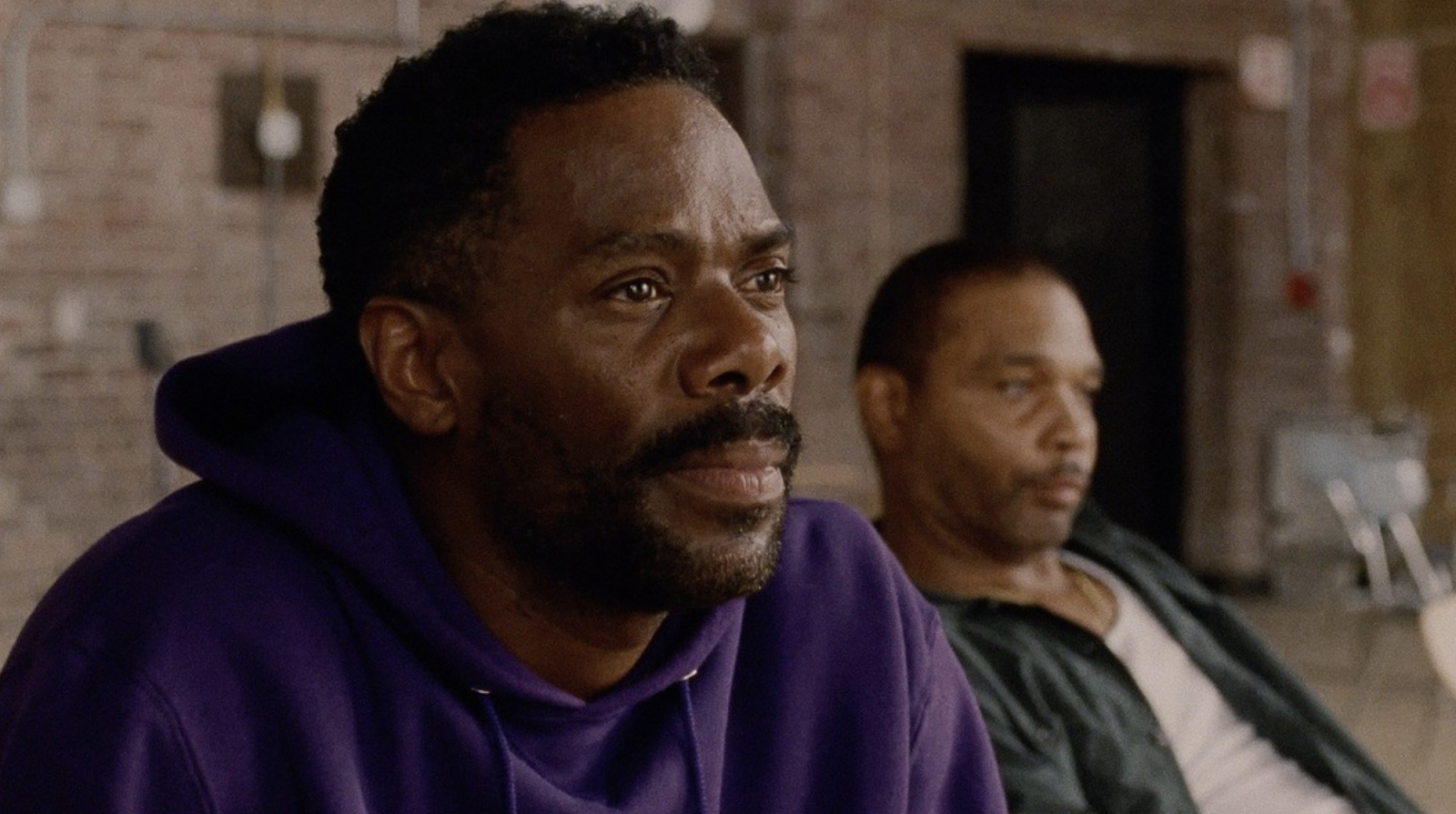
Colman Domingo and Clarence Maclin in
"Sing Sing"
Photo Credit: RottenTomatoes.com 

5. Sing Sing - When it comes to movies about the redemptive power of the arts, it’s always engaging to see how people’s lives can change when given an outlet to express themselves.  In this drama from director Greg Kwedar, we follow John Whitfield (Colman Domingo), an inmate at the titular prison, who gathers his fellow inmates to put on a theatrical performance through the Rehabilitation Through the Arts program.  Domingo gives a transcendent performance as a man who finds solace, possibility, and a sense of freedom in theater.  Paul Raci gives a great supporting performance as the prison’s theater director, but most of the supporting cast is made up of former inmates portraying themselves, most notably Clarence Maclin, all of whom provide stunning emotional work.  The screenplay by Kwedar and Clint Bentley does well in not just making this movie about its main character, but instead about all of the inmates, allowing us to get a sense who these people are, particularly in the audition scene and a mediation scene. Through this film, Kwedar creates an invigorating portrait of how the creative process can be therapeutic and encourage us to see the world in a whole new way, and in that, “Sing Sing” doesn’t make you feel anything less than alive.

Ralph Fiennes in "Conclave"
Photo Credit: RottenTomatoes.com

4. Conclave - The best thriller of the year comes from director Edward Berger, which is adapted from the 2016 novel by Robert Harris.  The movie follows Cardinal Thomas Lawrence (Ralph Fiennes) who, following the pope’s death, leads a conclave to elect his successor, all while discovering secrets about some of the top candidates.  Fiennes offers a captivating performance as a man who must make some difficult decisions and face difficult people.  Meanwhile, Stanley Tucci and Isabella Rossellini offer great supporting performances as a fellow cardinal and the cardinals’ head nun.  The screenplay by Peter Straughan constructs a thrilling and complex story that has you hooked as one revelation after another is made and threatens to complicate the papal voting process.  It all culminates in a surprise ending that had my audience muttering in surprise when it was revealed.  Berger maintains the white-knuckle tension throughout the film as matters become more difficult, while also knowing when to slow things down and create a sense of contemplation for the main character as he tries to keep everyone from turning against each other.  This is a movie you’ll want to see as soon as you can because if there’s one recent film where you definitely don’t want the surprises spoiled for you, it’s this.

Mike Faist, Zendaya, and Josh O'Connor in
"Challengers"
Photo Credit: RottenTomatoes.com

3. Challengers - One of the great powers that a sports movie can have is to get you interested in the sport that it depicts, even if you don’t follow it on a regular basis.  The latest to accomplish that is Luca Guadagnino’s film about a complicated love triangle between an injured tennis star, Tashi (Zendaya), her tennis champion husband, Art (Mike Faist), and her less-talented tennis-playing ex-boyfriend, Patrick (Josh O’Connor).  Zendaya gives an entertaining and layered performance as the woman in the middle of the romantic turmoil, while Faist and O’Connor have terrific chemistry in their humorous, yet tense competition that they have for tennis glory and Tashi’s affection.  The screenplay by Justin Kuritzkes goes back and forth in time through the tumultuous relationship of the main characters, making you feel like you’re at a tennis match as you try to keep up with everything that’s happening and always keeping your eye on the ball.  As a director, Guadagnino provides some of the best visuals of his career, immersing you in the thrilling action of the tennis matches and the romance that takes place off the court.  “Challengers” isn’t your typical sports movie, and it’s all the better for it.

Timothée Chalamet and Zendaya in 
"Dune: Part Two"
Photo Credit: RottenTomatoes.com 

2. Dune: Part Two - When director Denis Villeneuve released the first part of his two-movie adaptation of Frank Herbert’s iconic sci-fi novel in 2021, it was evident that the book was getting the big-screen treatment it deserved, and that continues with part two.  The story follows Paul Atreides (Timothée Chalamet) as he continues to lead the rebellion against the evil House Harkonnen on the desert planet of Arrakis.  Chalamet brings even more depth to his character in a performance that shows the massive changes in his arc.  He’s backed up by a stellar supporting cast, with the standouts being Zendaya, Rebecca Ferguson, and Austin Butler, who relishes his psychotic villain role.  Just like the first film, the screenplay by Villeneuve and John Spaihts includes enough of the details concerning the deep lore of the source material, while also making it accessible for moviegoers not familiar with it.  As a director, Villeneuve further cements himself as a mammoth force in the sci-fi genre, building eye-popping visuals that have you feel the massive scale of the worlds within the film.  With the stage set for “Dune: Messiah,” it’s clear Villeneuve has another epic installment in his hands.

Adrian Brody and Felicity Jones in
"The Brutalist"
Photo Credit: RottenTomatoes.com

1. The Brutalist - This year gave us what will surely be considered one of the great American film epics with director Brady Corbet’s enthralling piece of historical fiction.  The story follows a Hungarian-born architect, László Toth (Adrian Brody), who survives the Holocaust and immigrates to America.  He’s soon given the chance to work on a massive construction project for his new acquaintance, Harrison Van Buren (Guy Pearce).  Brody gives an inspirational and emotional performance of a man who tries to follow his dream in a country that might not accept him.  Pearce is intimidating as Toth’s not-so-trustworthy employer, and Felicity Jones is wonderful as Toth’s wife, Erzsébet.  The screenplay by Corbet and Mona Fastvold offers a sprawling view into the life of the main character, giving us a chance to see his arrival and assimilation into America in the first half, and then the unyielding passion for his work in the second act as he absorbs himself in his project.  Corbet offers visuals that beg to be seen on a big screen, visuals that absorb you in how László takes in his new surroundings.  This movie represents a filmmaker uncovering new heights with his talents, and there isn’t any doubt that he can, and will, go higher.

Sunday, January 26, 2025

2024 Movie Catchup

Before I finalize the list for my top 10 favorite movies of 2024, I decided to do a bit of catching up over the last month.  Given how many movies I had to see, I didn’t have much time to write full reviews.  So, here are some mini reviews for those films.
Demi Moore in "The Substance"
Photo Credit: RottenTomatoes.com 


The Substance
- One of the most audacious movies of the year, certainly in terms of style, was writer-director Coralie Fargeat’s body-horror satire.  The story follows an actress, Elisabeth Sparkle (Demi Moore), who’s let go by her producer (Dennis Quaid) because of her age.  She’s then introduced to the titular black market drug that allows her to grow a younger version of herself (Margaret Qualley), which soon leads to disastrous consequences.  Moore gives the best performance of her career in a heartbreaking and shocking portrayal of someone who isn’t ready to be forgotten, pulling the audience into the depths of her crippling self-consciousness.  Qualley gives a terrific supporting performance as the reckless younger self of Elizabeth, and Quaid is squirm-inducing as a sleazy producer.  Although Fargeat’s screenplay can get a little heavy-handed and over-the-top in the finale, it nevertheless offers a memorable narrative of what it means to be pushed aside because of your age, particularly in the entertainment industry.  As a director, Fargeat shows ample potential as our next great body-horror director, utilizing eye-popping practical effects with as little use of CGI as possible, going all in for the gross-out factors that might even have you watching some scenes between your fingers.  This is only Fargeat’s second feature, and if this is what she accomplishes this early in her career, we’ll be in for some whoppers later on.
Grade: A-

Nicholas Hoult in "Juror No. 2"
Photo Credit: RottenToamtoes.com
Juror No. 2
- Although Clint Eastwood is an iconic American director who has enjoyed a mammoth career, it’s hard to deny that his output of the last 10+ years has been wildly inconsistent.  However, despite being 94, he shows that he still has the talent to make something good if the right material is there, as evidenced by this legal thriller.  The story follows Justin Kemp (Nicholas Hoult) who gets called to jury duty for a murder trial.  Not long into the proceedings, he realizes that he might be responsible for the victim’s death.  Hoult gives us a superb performance of someone who’s caught in preserving his own life when that of another is on the line, with some of his finest moments coming from just using his facial expressions to show Justin processing new details about the case and figuring out how it could implicate him.  The screenplay by Jonathan Abrams is constructed as an old-fashioned courtroom drama, but that doesn’t make the story any less engaging, with him offering revelations that keep us wondering about Justin’s innocence and guilt.  It all culminates in an ending that will surely get viewers debating.  Eastwood isn’t a filmmaker who adds a lot of visual flourishes, but that isn’t a bad thing.  His straightforward direction shows his ability to let pure tension and drama do the work, all while having his actors give grounded performances that ring true.  As Eastwood has you sit in court, you’ll be absolutely riveted.
Grade: A

Elle Fanning and Timothée Chalamet
in
"A Complete Unknown"
Photo Credit: RottenTomatoes.com
A Complete Unknown - When you think of musicians from the 20th century and all of the icons that grew from there, it’s impossible to not think of Bob Dylan.  His influence of the last few decades is unmistakable, and his career now goes from the stage to the big screen with director James Mangold’s biopic.  The story follows Dylan (Timothée Chalamet) and the beginning of his career in 1961 to 1965, where he made the controversial choice to switch from an acoustic guitar to an electric, which was seen by his fans as a betrayal of his folk-music roots.  Through his dialogue and singing, Chalamet masters the vocals of Dylan, fully inhabiting his character and displaying how much work he put into bringing the singer’s talent to cinema.  There are some good supporting performances from Edward Norton and Elle Fanning, but the standout is Monica Barbaro, who’s absolutely magnetic as singer/songwriter Joan Baez.  However, the screenplay by Mangold and Jay Cocks, which is based on Elijah Wald’s 2015 book “Dylan Goes Electric!,” is a rather repetitive approach to its subject, mostly being one musical performance after another with just a few minutes of drama in between, as if they figured it would be enough for viewers to just hear the songs they’ve come to love.  Meanwhile, Mangold’s direction feels like it’s on autopilot to just deliver a standard musician biopic.  While it was important for the performances, especially the central one, to be on point for a movie like this, Dylan’s legacy needed more than that.
Grade: B-

Pamela Anderson in 
"The Last Showgirl"
Photo Credit: Imdb.com
The Last Showgirl - On this list is a film that would make a suitable, albeit very different, companion piece to “The Substance,” in that it tackles the subject of aging in the entertainment industry.  Director Gia Coppola’s drama follows Shelley Gardner (Pamela Anderson), a seasoned Las Vegas showgirl.  When her show announces its closure after 30 years, Shelley is faced with an uncertain future.  Anderson gives a sweet and loving, yet heartbreaking performance of a woman who’s passionate about what she does, but now must confront a possible life without it.  This is stunning work from Anderson that creates a whole new chapter in her career as a true film actress.  Backing her up are great supporting performances from Jamie Lee Curtis, Brenda Song, and Kiernan Shipka, with the standout being Dave Bautista, who does some of his best work to date in an understated, yet strong performance as the show’s producer.  While the screenplay by Kate Gersten, which was based on her play “Body of Work,” has some cliches of redemption and reconnecting with family, it also has a couple of small, yet effective dramatic twists that provide some depth to the character study at the center.  As a director, Coppola uses cinematography from Autumn Durald Arkapaw that’s shot in 16mm, providing a graininess that fits well with the setting, as well as extensive closeups that really help the emotions from the characters land.  When it comes to “The Last Showgirl,” if you want to see a movie led by an actress with freshly discovered talent, this is it.
Grade: A-

Colman Domingo and Clarence Maclin in 
"Sing Sing"
Photo Credit: RottenTomatoes.com
Sing Sing - When it comes to movies about the redemptive power of the arts, it’s always engaging to see how people’s lives can change when given an outlet to express themselves.  In this drama from director Greg Kwedar, we follow John Whitfield (Colman Domingo), an inmate at the titular prison, who gathers his fellow inmates to put on a theatrical performance through the Rehabilitation Through the Arts program.  Domingo gives a transcendent performance as a man who finds solace and possibility in theater, as well as a sense of freedom behind prison walls.  Paul Raci gives a great supporting performance as the prison’s theater director, but most of the supporting cast is made up former inmates portraying themselves, most notably Clarence Maclin, all of whom provide stunning emotional work.  The screenplay by Kwedar and Clint Bentley does well in not just making this movie about its main character, but instead about all of the inmates, allowing us to get a sense who these people are, particularly in the audition scene and a mediation scene.  With the help of cinematography by Pat Scola, Kwedar shoots the film on 16mm, which allows us to connect deeper with the setting because of how natural the visuals look, just like with “The Last Showgirl.”  Through this film, Kwedar creates an invigorating portrait of how the creative process can be therapeutic and encourage us to see the world in a whole new way, and in that, “Sing Sing” doesn’t make you feel anything less than alive.

Grade: A

Friday, January 24, 2025

In America, an Immigrant Architect Builds His Future

Adrian Brody and Felicity Jones in 
"The Brutalist"
Photo Credit: RottenTomatoes.com
Period dramas, especially historical ones, have transported audiences for decades to times and places that offer a richness in what they could teach us about the past.  Whether the story takes place over a couple of years or several, these types of stories make the histories of these eras come alive in the details of the set designs, the knowledge behind the screenplay, and the cast members who study their roles to invest audiences in their true-to-life portrayals.  However, there are times when a movie will approach the past from a historical-fiction perspective, constructing made-up, yet fascinating events that allow us to view history through a new lens.

Director Brady Corbet does this as a mammoth filmmaking accomplishment with his epic drama, “The Brutalist.”  Boasting emotional performances, a captivating story, and a sense of scale that can only truly be experienced on a big screen, Corbet gives us a cinematic journey that feels like a one-of-a-kind movie.

László Tóth (Adrian Brody) is a Hungarian-born Jewish architect who survives the Holocaust and immigrates to the United States.  When a wealthy client, Harrison Lee Van Buren (Guy Pearce), offers László the chance to oversee a massive construction project, he will face events that’ll alter his views on what it means to pursue the American dream.

Similar to what Brody did with his performance in 2002’s “The Pianist,” he brings to life a character who uses his talents to overcome the horrors of what he has experienced, making this a galvanizing performance that belongs in the epic scope of the film.  Brody has an ability to go between the sadness of the toll that his character’s past has on him, but also the ambition of wanting to make something of himself in a country that might not want him.  As Brody shows the increasing resilience of what László wishes to achieve, it all makes for an inspiring performance in the middle of the intense heartache that he continues to face.  Brody pours so much emotion into this role, whether it be the love for his family or his dedication to his work, and he leaves it all out there in order to depict a character who wants to do anything to make sure that people see his talent.

Pearce gives a terrific performance as a man who seems like he has László’s best interests in mind, but proves otherwise later on.  He does superb work in making you feel the trust that László feels as he starts working with him, seeming like his life is now on the right track.  However, as the movie goes forward, the self-interest that Pearce exemplifies has you tense up as you wait to see how he’ll interact with László as their collaboration slowly becomes more strained.

Felicity Jones is absolutely engaging as László’s wife, Erzsébet.  Despite her character having a soft personality, Jones brings across the assertiveness that Erzébet needs in order to defend László when his goals begin to crumble and those around him begin to doubt or take advantage of him.  Jones exhibits Erzsébet’s ability to put herself forward as someone who, just like her husband, has to show that she belongs in America and has the work ethic to make her dreams become a reality.

Other great supporting performances come from Joe Alwyn as Harrison’s son, Harry; Raffey Cassidy as László’s mute niece, Zsófia; and Alessandro Nivola as László’s cousin, Attila.  All three of them make the most of their screen time in this massive film, making sure you remember them amongst the three central performances as they make their impact on László’s life.

The screenplay by Brady Corbet and Mona Fastvold (his frequent writing partner) is broken up into two parts and an epilogue, with the first part focusing on Laszlo’s arrival and project planning, the second part focusing on the construction of the project, and the epilogue focusing on the culmination of his career.  Through this, we get a complex and engrossing view into the two halves of Laszlo’s dream: the beginnings of his contributions to his new homeland, and what becomes of it as everything starts to progress.  Although László Tóth wasn’t a real person, the detail that Corbet and Fastvold put towards his character and story against the historical backdrop very much makes him seem someone who’s a real-life and larger-than-life figure.  The screenwriting duo offers both a gripping look into László’s strive for greatness and a fascinating look into the facets of architecture.  We see László through his personal and professional lives, leaving you absorbed in how they play out separately and how they eventually collide.

I was lucky enough to experience this movie on the IMAX format, and if it’s available on such a format near you, I couldn’t recommend more that you see the movie on that type of screen.  Corbet re-teams with Lol Crawley, who provided the camerawork for Corbet’s other two films, “Vox Lux” and “The Childhood of a Leader.”  With Crawley’s absolutely majestic cinematography, we experience America through the eyes of László.  Aside from the gargantuan imagery that we see in the different settings, Crawley also uses many single takes that allow the drama to unfold at a steady rate as the camera follows the actions and conversations of the characters, immersing us in both the people and the places that they inhabit.  Two fine examples of this is one of the first scenes that has the camera follow László as his ship approaches Ellis Island and he walks from the steerage level to the upper decks, all while walking through a claustrophobia-inducing crowd of people, leading him to outside as he gazes upon the Statue of Liberty for the first time.  The other instance is a climactic dinner scene near the end of the film, of which I don’t want to give much away.  These are two of the most memorable scenes of not just of the film, but of any film in 2024.

This is Corbet’s first movie in six years since his 2018 drama “Vox Lux,” and you can see all of the dedication that he’s put into making sure every ounce of his vision is shown to moviegoers. While “Vox Lux” wasn’t great in terms of its story, Corbet proved himself to be inventive with his visuals, and that ability is seen tenfold in this film.  Also, despite this movie being a sprawling period piece, Corbet crafts the movie in such a way that seems to make it glide smoothly along to the point where you don’t even feel the movie’s three-and-a-half-hour length.  He prevents this from becoming a typical Oscar-bait movie and instead uses his camera to create imagery that can be either beautiful or tense, finding inventive and occasionally thrilling ways to visualize the story.  Throughout all of this, he uses a score by Daniel Blumberg that can be triumphant in some scenes and eerie in others, evoking feelings of both possibility and uncertainty as László experiences accomplishments and downturns.

Corbet gives us a towering achievement in film that makes the most of its narrative and technical canvases.  In a year full of cinematic skyscrapers, “The Brutalist” emerges as the tallest.

Grade: A

Thursday, January 9, 2025

New Life and Blood in a Vampire Legend

Nicholas Hoult in "Nosferatu"
Photo Credit: RottenTomatoes.com

In 1922, German director F.W. Murnau wanted to film an adaptation of Bram Stoker’s groundbreaking vampire novel, “Dracula.”  Having failed in securing the rights, he made an “unauthorized” adaptation called “Nosferatu,” which told the same story as Stoker’s creation, but with different names for the characters and a change of setting.  In the decades since, the film became one of the most recognized amongst silent films and the horror genre, due to its iconic imagery and chilling performance from Max Schreck as the titular character.  Then, in 1979, Werner Herzog wrote and directed a remake, “Nosferatu the Vampyre,” a rare horror remake that lived up to the legacy that was set by the original.

Now, writer-director Robert Eggers resurrects this enduring villain in his vision of the story.  With “Nosferatu,” he delivers the best horror film of the year with intense performances, a classically scary story, and a clear admiration for the source material, continuing his ability to bring his audiences into the depths of darkness.

In 1838, Ellen and Thomas Hunter (Lily-Rose Depp and Nicholas Hoult) live in Wisborg, Germany, with her husband, Thomas (Nicholas Hunter).  As an estate agent Thomas’ latest assignment sends him to a castle in Transylvania to meet with the reclusive Count Orlok (Bill Skarsgård) to sell him a mansion in Wisborg.  Upon the two of them meeting, Orlok will unleash terrifying events that put Thomas, his family, and friends in danger.

The horror genre was loaded with stellar performances in 2024, and Depp’s leading work is an unforgettable capstone on the year.  Depp’s performance in this film is the first that I’ve seen from her, and she leaves it all on the screen as someone who’s both terrorized and enraptured by her darkest desires.  Through her portrayal, Depp does an impactful job in exhibiting the hold that Orlok has on her, seeming to always lurk in her mind as she tries to maintain her love for Thomas.  However, this isn’t just a performance that’s deeply emotional, but also one that’s incredibly physical.  Some of Depp’s best moments from her performance is when she has to show Ellen being possessed by Orlok’s power.  The unnatural and disturbing ways in which Depp moves her body will have you unable to look away, absorbing you in the horror of what Orlok could do to someone with whom he’s obsessed.  Depp doesn’t do anything less than throw herself into the grips of this character, leaving you absolutely hooked to her arc.  

Just as Skarsgård accomplished with his portrayal of Pennywise the Clown in Andy Muschietti’s two-part film adaptation of “It,” he displays an ability to bring his own stamp to an iconic horror villain.  Similar to his unsettling circus getup in “It,” Skarsgård shows that he can act with the makeup and beyond it.  With a catacomb-deep voice and his natural physicality, he brings a performance that’s equal parts frightening and magnetic.  Even in his earlier scenes where he’s obscured, Skarsgård ensures that you’ll feel Orlok’s presence as the aura of dread that he carries permeates through the screen and into the shadows of the theater.  

Hoult delivers a performance that brings out both the love for his wife and the nerve-racking fear that climbs as he spends more and more time with Orlok.  From the beginning, Hoult brings out Thomas’ sense of professional ambition and duty to provide for his household, but also shows someone who has a tinge of nervousness as he sets out on his pursuits.  It’s a touch of fear that unravels his persona where Hoult exhibits the frightful hold that Orlok has on him, having us feel the crippling terror that infects him at the castle and stays latched on to him when he returns home.

Other strong supporting performances include Aaron Taylor-Johnson and Emma Corrin as Friedrich and Emma Harding, close friends of the Hunters; Ralph Ineson as Wilheim Sievers, a doctor who attempts to treat Ellen; and Simon McBurney in a disquieting performance as Herr Knock, Orlok’s loyal servant.  However, the standout is Willem Dafoe as Professor Albin Eberhart Von Franz, an expert in mysticism and the occult.  In an engaging performance, he exhibits the unwavering conviction of his beliefs and knows what sacrifices have to be made to defeat the evil that plagues them.

The screenplay by Eggers offers a faithful adaptation of Murneau’s film, and Stoker’s novel by extension.  It’s a horror narrative that dives deep into the dark desires that can take hold of people, all while showing how those temptations seem all the more enticing when those feelings are told to be shut away, such as society was in the time period of the film.  All of this is encapsulated in the romance between Ellen and Thomas vs. the forbidden love between Ellen and Orlok.  Eggers constructs a disturbing love triangle that immerses you in its light-against-darkness fight that becomes more and more disturbing as Nosferatu closes in on Wisborg, with Eggers building up the events with steadily mounting danger that not only puts the audience on edge, but also adds depth to the characters as they try to protect those they love.

Jarin Blaschke, who provided the cinematography for Eggers’ other three movies, does some of his finest work yet in his latest collaboration, providing the beautiful, yet haunting visuals that we’ve come to expect from his work.  Besides his usual talent with full capturing Eggers’ detailed sets, which he does through several great single takes, he proves to be a master of tantalizing concealment as we’re introduced to Orlok.  Whether he keeps him out of focus, in shadows, or just out of frame, his camerawork has us leaning forward in our seats as we try to get a better look at him, all while our heart rate increases as we continue to anticipate the potential reveal.  Another notable aspect of his lensing and Eggers’ blocking is how the characters are often framed in profile or are partly in the dark, memorably visualizing the theme of people in this era conceding to societal norms, but also having hidden aspects to their personas that they’re tempted to reveal.

Just as he did with his other movies, Eggers and his team’s attention to period detail is astounding.  When it comes to the production design from Craig Lathrop, who worked with Eggers on his other three films, the duo doesn’t do anything less than transport us to the time and place of the story and steep us in the relentless dread that covers everything like a crushing fog.  With Orlok’s castle and the streets of Wisborg, Eggers utilizes his directing skills and arsenal of technical talent to put his horror-filmmaking heart and soul into this interpretation, calling to mind the immaculate visual work of Francis Ford Coppola’s 1992 adaptation of “Dracula.”  Encompassing all of this is a slow-burn tone that we’ve come to know from Eggers’ horror films, spending a lot of time adding depth to the characters and their environments so that we can grasp the weight of this emotional and dangerous journey.

With “Nosferatu,” Eggers wipes the dust from Orlok’s coffin, awakening him once again, and it was worth the wait.

Grade: A

Monday, December 30, 2024

Two Witches Take an Unlikely Friendship Towards Destiny

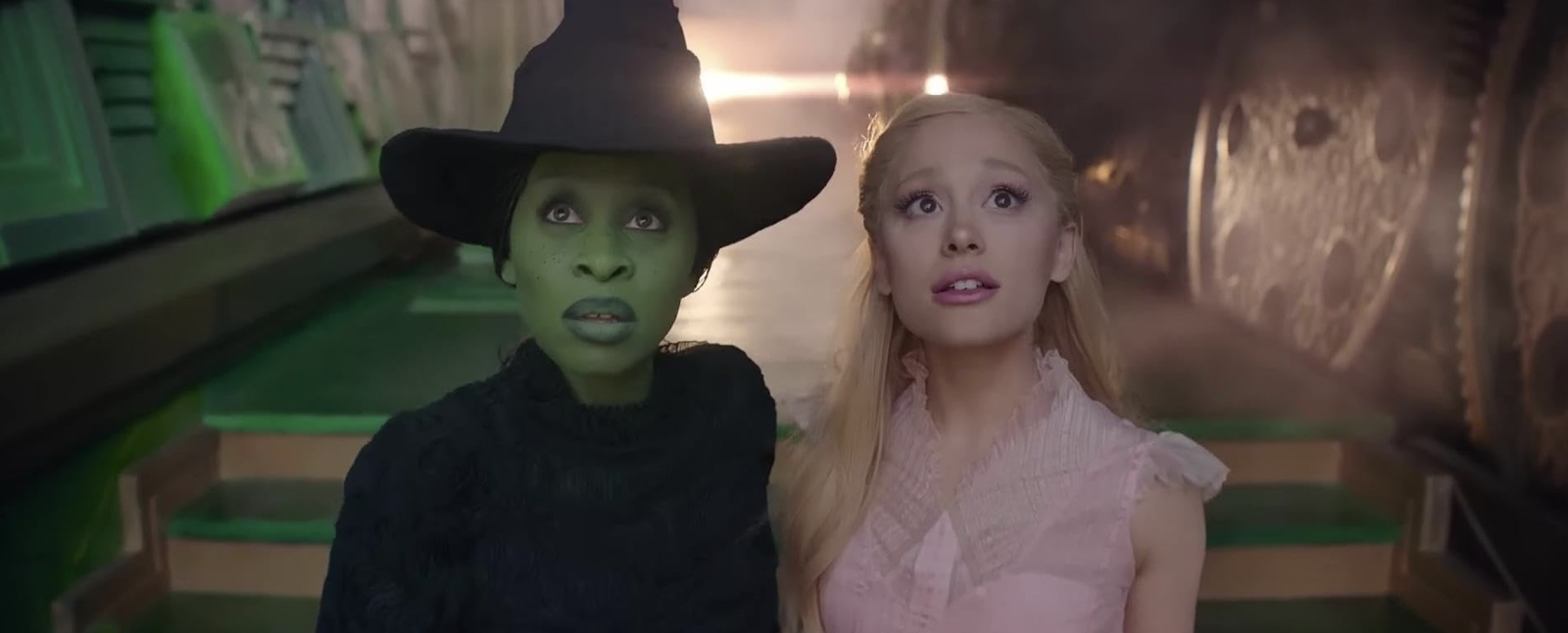
Cynthia Erivo and Ariana Grande in "Wicked"
Photo Credit: Imdb.com

In 1995, author Gregory Maguire wrote the first novel in his “Wicked Years” series, “Wicked,” which told the story of the early life of the “Wonderful Wizard of Oz” main villain, the Wicked Witch of the West.  Filled with elements both fantastical and political, the novel delivered a detailed backstory to one of children literature’s most enduring classics, albeit with more of an adult audience in mind.

Then, in 2003, playwright Winnie Holzman brought Maguire’s story to the Broadway stage with music and lyrics from the legendary Stephen Schwartz.  With eye-popping sets, colorful costumes, iconic songs, and an engaging friendship at the center of the story, it’s not hard to figure out why the show has lasted for as long as it has.  To this day, it’s the only Broadway musical that I’ve seen twice.

Now, 21 years later, “Wicked” comes to the big screen with part one of a two-part adaptation.  Boasted by exuberant direction from Jon M. Chu, lavish technical achievements, and a perfect duo of lead performances, “Wicked: Part One” gives the long-running musical the cinematic treatment that such an epic, humorous, and emotional story deserves.

Before the events of “The Wizard of Oz,” the Wicked Witch of the West was just Elphaba Thropp (Cynthia Erivo), a student enrolled at the prestigious Shiz University.  While there, she meets Glinda Upland (Ariana Grande), who’ll later become the Good Witch of the North.  While they couldn’t be more different at the start, the two eventually develop a friendship that will put them on a course towards a fate that neither could’ve imagined.

Erivo delivers a beautiful performance as Elphaba, exhibiting someone who has gone through her whole life being ridiculed for circumstances beyond her control, but showing an ability to let the gawking and insults roll off of her and know how to handle the derision.  She brings out someone who knows what she’s capable of during her joyous rendition of “The Wizard and I,” but is also aware of her limitations with the quietly sad “I’m Not That Girl.”  There’s a hopefulness and poignancy that Erivo brings to her character that presents Elphaba as someone who wants to find her place in the world, a world that seems to not want anything to do with her.  With that, Erivo masters Elphaba’s emotional evolution that culminates in her triumphant rendition of the film’s closing song, “Defying Gravity,” a sequence that perfectly sets the stage for what’s to come for Erivo’s turn as the Wicked Witch of the West. 

For Grande as Glinda, there couldn’t have been a better choice for someone who can exhibit the bubbly, queen-bee persona of this character.  Grande delivers one of the most fun performances of the year, portraying someone who’s the total opposite of her co-lead.  She floats and gently glides through her performance, bursting with life and relishing the chance to bring this character to the big screen.  With her character’s signature scene being when she sings “Popular” in trying to give Elphaba a makeover, you see the absolute charm and humor that Grande brings to her portrayal of Glinda, showing an actress who’s having an absolute ball with a role that’s a perfect match of actress and character.  In the middle of all of Glinda’s pep, Grande also instills moments of warmth and understanding with her character as she starts to bond with Elphaba, adding some true emotion to Glinda that will have a significant impact in the second film.

As a leading pair, Erivo and Grande dig into the wit of their characters’ initial opposition, such as in the musical number “What Is This Feeling?,” and the dramatic apex of their arc with “Defying Gravity.”  Both actresses portray their characters to full emotional and comedic heights that create a tremendous dynamic that pairs well with the grandness of the sets and visual effects that we see on screen.  Between their talents in singing and acting, Erivo and Grande make every moment of their shared screen time soar as they transition from bitter enemies to best friends.

Jonathan Bailey, who plays Prince Fiyero Tigelaar, a transfer student and love interest of Glinda, brings an abundance of suaveness to his role.  In his song, “Dancing Through Life,” Bailey is the very definition of the life of the party as he encourages his fellow classmates to toss away all of their cares and instead have a night of revelry at the bustling Ozdust Ballroom.

Other entertaining supporting performances include Michelle Yeoh as Madame Morrible, the Dean of Sorcery at Shiz; Jeff Goldblum as the Wizard of Oz; Marissa Bode as Nessarose, Elphaba’s little sister; Ethan Slater as Boq Woodsman, a Munchkin and Shiz student who’s in love with Glinda; and Peter Dinklage as the voice of Dr. Dillamomd, a talking goat who’s a history professor at Shiz.  All of these cast members inhibit the humor and/or drama that their characters need, adding their own little bit of color to a movie that’s already overflowing with it.

The screenplay by Winnie Holzman and Dana Fox captures the strong character dynamics just as in-depth as the show and the novel.  While Maguire’s book goes deeper into the social and political problems facing Oz compared to the Broadway adaptation, Holzman and Fox’s script maintains the show’s balance between the “Wizard of Oz” sense of whimsy and the darker themes of the novel, without having the latter feel like it’s been watered down, thereby crafting a story that could be appreciated by both children and adults.  Despite the movie being two and half hours, which is just about the length of the full Broadway show, the runtime is more than justified.  It allows us to take in the world of Shiz University and Oz and the characters that inhabit those settings, while also further exploring the friendship between Elphaba and Glinda, which will face bigger challenges in part two.  

Chu, who directed the film adaptations of the Broadway musical “In the Heights” and the novel “Crazy Rich Asians,” knows how to utilize expansive sets and colorful visuals to immerse his audiences in his storytelling.  Just as he did with “In the Heights,” Chu shows his talents for filming complex musical sequences, this time using sets that are even more intricate and working well with special effects to bring Shiz and Oz to its full vibrancy.  Right from the opening scene of “No One Mourns the Wicked,” it’s clear that Chu is going to capture the full cinematic potential of this musical.  He re-teams with “In the Heights” cinematographer and editor, Alice Brooks and Myron Kerstein, respectively, to create song-and-dance sequences that deliver on the drama and spectacle of the Broadway show.  Each musical number is made with the utmost care to make it come alive on screen, ensuring that people who have experienced this story on Broadway will feel like they’re seeing the show again for the first time.

Chu and his accomplished cast and crew have gifted us a superb musical that will surely amp up the excitement for part two, “Wicked: For Good,” which is scheduled for release on November 21, 2025.  With the “Wizard of Oz” stories that have been told through books, film, and Broadway, “Wicked: Part One” now has a place in a legacy that’s as long as the yellow brick road.

Grade: A

Sunday, December 22, 2024

Without Words, a Universal Message

"Flow"
Photo Credit: RottenTomatoes.com
When it comes to animation, presenting a story without dialogue can make it that much more impactful.  While it doesn’t happen that much these days, we’ve had some superb examples of wordless storytelling over the last couple of decades in the animation genre.  In the moments when animation deals with non-human characters, it’s easier to give yourself over to such a story that’s told in that form of the medium, as it somehow seems to fit.  Walt Disney Feature Animation did this with the opening sequence of “Dinosaur”; Pixar has done it with their animated shorts and the opening third of “WALL-E”; and, a few months ago, we got the latest example with writer-director Pablo Berger’s masterful “Robot Dreams,” an animated feature that didn’t have any dialogue, but was able to convey a humorous and poignant story nonetheless.  It was the latest testament to what animation can do with just the power of its images.

Now, Latvian director Gints Zilbalodis accomplishes such a storytelling feat with his film “Flow.”  Bringing us wonderful animation and a beautiful narrative about survival, Zilbalodis delivers one of the best films of the year and THE best animated film of the year.

In a world that’s in ruins from an environmental disaster, a black cat, a Labrador Retriever, a capybara, a secretary bird, and a ring-tailed lemur try to stay alive as they traverse dangerous terrains.

Since there isn’t any dialogue, the animators did superb work in making the animals as expressive as possible.  Through the use of actual animalistic noises (which were recorded by sound designer Gurwal Coïc-Gallas) and the way the characters interact with each other, both in subtle and direct ways, you can see what’s going through their minds as they attempt to navigate a world that poses several deadly threats.  Without the animals talking, we’re encouraged to pay even closer attention to them as we watch and analyze their body language in the quieter moments and the bond between the five of them deepens.

The screenplay by Zilbalodis and Matīss Kaža may seem simple on the surface, but they offer many layers to a story about these unlikely friends and what they do to survive.  Every scene brings a new danger or a new character, leaving you absorbed in how this adventure will unfold.  With the story taking place in an unspecified country, this allows for the screenwriters to include animals from different parts of the world and incorporate a universality to the film’s message by having these species group together.  There are so many things that the writers allow us to read into and ponder the meaning of, leaving it solely up to the images instead of dialogue to get their points across, and the screenplay is all the more meaningful for it because of the chance to let us meditate on everything.

As a director, Zilbalodis makes sure that his animation stands out from what we usually see these days.  While most animated films typically use the most up-to-date 3D computer animation, this movie was constructed on an open-source software program called Blender.  The animals and environments are three-dimensional, but not in the glossy way that we see in most modern animation, but that’s not a complaint.  What we do see is something that shows you what can be done in animation without the biggest and brightest tools.  Here, we see the hard work that went into putting this movie entirely on the software.  The way in which Zilbalodis creates the visuals sweeps us away every bit as much as what you would see in any Pixar movie.  Between the movements of the animals and the details of the environments through which they travel, Zilbalodis keeps viewers invested in the adventure as we travel through forests, sail on rising waters, and visit crumbling civilizations.  During the film, Zilbalodis employs many single takes as he brings us across the different terrains of the film, allowing us to feel absorbed in the settings as we walk, run, swim, and fly with the characters.  Through all of this, he maintains an enchanting, yet tense tone that has us entertained by this unlikely fellowship, but also fearing for their survival.

Through its engaging visuals and minimalist, yet impactful sorry, “Flow” is a wordless movie that speaks volumes.

Grade: A

Monday, December 2, 2024

More Than Two Decades Later, Ridley Scott Takes Us Back to the Arena

Paul Mescal in "Gladiator II"
Photo Credit: RottenTomatoes.com

In 2000, director Ridley Scott gave moviegoers a brutal and emotional historical epic with “Gladiator,” starring Russell Crowe as Maximus Decimus Meridius, a general-turned-gladiator who fights to avenge his family’s death.  This was made-for-the-big-screen filmmaking for which Scott had become known, and with a powerful lead performance, a sweeping story, and intense battle scenes, Scott delivered one of the most iconic movies of the 2000s and remains one of his most notable.

Now, nearly a quarter of a century later, Scott brings us back to Rome with his long-gestating sequel, “Gladiator II.”  Despite some good performances and the director’s knack for mammoth cinema being very much on full display, this continuation comes up fairly short of Scott’s enduring modern classic.

Sixteen years after the death of Marcus Aurelius, his grandson, Lucius Verus Aurelius (Paul Mescal), has been living in the North African kingdom of Numidia after his home was invaded.  Following a defeat in battle, Lucius is enslaved and taken as a slave to flight as a gladiator in Rome, which is ruled by the tyrannical twin emperors, Geta (Joseph Quinn) and Caracalla (Fred Hechinger).

While it’s difficult to perform in the shadow left by Crowe, Mescal does what he can to provide a performance of grit as someone who’s forced to fight for his freedom.  He has the physicality that Crowe brought to his role as Maximus, showing a commitment to performing the ferocity of the gladiatorial fights and exhibiting a spirit built on valor that’s needed in order to survive.  As Mescal has shown in movies like “God’s Creatures,” “Aftersun,” and “All of Us Strangers,” he’s proven to be a capable dramatic actor, and when the story gives him a little bit of depth with which to work, his talent shines through.

Just like Mescal, even though there’s not much to the characters on the page, the supporting performers still try to make something out of what’s given to them.  There’s Denzel Washington, who brings his infallible charisma as Macrinus, Lucius’ mentor; Pedro Pascal as Acacius, a conflicted army general; Connie Nielsen returns as Lucius’ mother, Lucilla, who tries to maintain her strength in the middle of arduous political strife; Quinn and Hechinger as bloodthirsty rulers; and Alexander Karim as Ravi, a gladiator-turned-doctor for wounded fighters.

The screenplay by David Scarpa offers some enticing political intrigue that adds a little bit of depth to the characters, but for several of them, you really don’t feel like you get to learn much about them that sticks out.  With the first “Gladiator,” you spent much of the first third getting to know the characters after the opening battle sequence and before Maximus gets enslaved as a gladiator.  Here, the narrative goes into the gladiatorial fights not long after the film’s big opening, as if assuming the viewers will be impatient to get to that aspect of the story.

Even though none of the character arcs are fleshed out, and without giving away plot details, it’s clear that the one involving Acacius and Lucilla had the most potential and should’ve been the main plot of the story, instead of the movie trying to follow a lot of the same beats as the first film.  When you have a big-scale historical epic such as this, you need characters who are as grand and layered as the setting they inhabit, and what we saw in that in terms of the 2000 film unfortunately doesn’t carry over to this film.  Given the 24-year wait for this sequel, we should’ve had a story worthy of the wait, one that can match the emotional impact of the original.  Unfortunately, that part of the original’s magic is missing.

Ever since the original “Gladiator,” Scott continued with a string of epics like “Kingdom of Heaven,” “Robin Hood,” “Exodus: Gods and Kings,” “The Last Duel,” and last year’s “Napoleon.”  While the quality amongst these films was very inconsistent, it’s hard to deny the work ethic that Scott exhibits in bringing these stories to life.  Despite some very shaky visual effects throughout “Gladiator II,” Scott still brings out the craftsmanship that we’ve come to expect from him.  Assisting with this is John Mathieson, who has provided the cinematography for several of Scott’s films, including the original “Gladiator” (which was his first collaboration with the director) and offers his typically grand camerawork to transport us away back to this era.  Scott and Mathieson do well with the grand views of battle in the opening sequence, while also delivering imposing, yet stunning views from inside the Colosseum.  Even though the story is the weakest part of the film, the movie is somewhat redeemed by the thrilling, epic-scale imagery of the gladiatorial fights.  Mathieson has worked with Scott for over two decades, and it’s clear that  they still have a strong partnership when it comes to making their technical ambitions evident on screen.

Scott remains one of today’s notable big-name directors, so it’s easy to understand the irresistible feeling of wanting to see a long-awaited sequel to one of his most popular films.  It has its ups and downs, and while the emperor gives his thumbs up or down to determine the fate of a gladiator, you’ll probably find yourself bringing it halfway.

Grade: B-

Sunday, November 24, 2024

In a Strange House, a Test of Faith

Hugh Grant, Sophie Thatcher, and Chloe East 
in "Heretic"
Photo Credit: Imdb.com
Many classic horror films have dealt with religion in one way or another.  Whether it’s classics like “The Exorcist,” “Rosemary’s Baby,” and “The Omen,” or modern examples like “The First Omen,” “Immaculate,” or “The Vigil,” the genre has tackled this subject in fascinating ways that have shown how the characters view their faith and how their beliefs play into the wider scope of the different horror narratives.  These movies have had an impact because of how much religion plays into the everyday lives of countless people.

Writers-directors Scott Beck and Bryan Woods have now made their stamp on religion-themed scares with their psychological-horror thriller, “Heretic.”  Boasting a devilish lead performance, a thought-provoking story, and an enticing setup, Beck and Woods bring us a horror film that delivers on emotion, smarts, and chills.

Sister Barnes (Sophie Thatcher) and Sister Paxton (Chloe East) are Mormon missionaries trying to look for new converts.  On one of their outings, they visit the house of Mr. Reed (Hugh Grant), an enigmatic, yet seemingly kind individual.  However, Barnes and Paxton soon realize he has trapped them in a dangerous game, one that will test just how strong their beliefs really are.

While we saw Grant go against his good-guy type and play a humorous villain in “Paddington 2,” he maintains some of his usual bumbling wit near the beginning of this film, only to go somewhere deeper on the spectrum of villainy this time around.  Here, he portrays an individual who has an unsettlingly affable and very calculated way of presenting himself as he tries to keep Sisters Barnes and Paxton ensnared in his trap.  You can see him absorbing the situation as the Sisters enter his house and he plans what comes next, and Grant’s disquieting performance always keeps you on edge as you watch him make the steady shift from his familiar Hugh Grant-persona to something more on the malevolent side.  All of this makes for one of the year’s finest performances as Grant’s sense of menace grows stronger and his character brings the Sisters deeper into his game.  For someone who almost always portrays nice-guy characters, Grant looks like he’s relishing this opportunity to slowly shed the charming persona we’ve come to know through decades of him being in romantic comedies.  Grant will certainly make a believer out of you with what he can do when portraying a villainous character, and I can’t wait to see in which genre he does this next.

Thatcher and East have terrific chemistry as they show a believable naïveté as they walk into what seems like a benign situation.  When they become more and more aware of what’s happening, Thatcher and East are engaging to watch as they try to take in their surroundings and be on their guard for what Mr. Reed might have planned for them.  They provide great work in exhibiting how they try to understand this danger that breaks their sheltered view of the world, and Thatcher and East show a thrilling increase in prowess and resilience as they try to beat Mr. Reed at his own game.

The screenplay by Beck and Woods creates a slow-burn story that’s all the more nerve-racking because you wait to see what kind of move Mr. Reed will spring next.  While this movie is a great horror story, it’s also an intriguing and in-depth view of the characters, with each section of the movie revealing things about them that drive the next section of the film.  There’s a good deal of the runtime that’s dedicated to the immersive dialogue, but the tension never falters because of how well the narrative constructs a scenario that has the characters question their beliefs.  Aside from this, the narrative boasts a clever setup of different parts of the house acting as figurative states of living, being in purgatory, and being dead, and it offers fascinating viewing to see how the faith of the characters plays into each section.

Beck and Woods created unbearably tense situations as writers on the first “Quiet Place” movie, and as directors, they translate that screenplay talent when taking the directorial reins of “Heretic.”  With just a limited cast and location, they’re able to maintain the apprehension throughout as we’re placed in close quarters with the characters, having us experience the layers of the discussions that the characters have, while also giving us an unease of being trapped with a stranger.  For this sense of closeness and claustrophobia, Beck and Woods get help from cinematography by Chung Chung-hoon.  In terms of lensing the interiors of an odd house, his talents come through, calling to mind how memorably he photographed the Neibolt house set-piece in “It: Chapter One.”  Here, he captures the details by framing the sections of the house in such a way that encourages us to move our eyes across the screen to take in every detail and figure out what it means in the overall scheme of Mr. Reed’s treacherous game.  He employs a slow and smooth camera that eases us into the situation and maintains such movements to keep that simmer going as you remain on the lookout for clever visual clues.

2024 has had its share of superb original horror films, like “The Substance,” “Oddity,” “Longlegs,” and “Late Night with the Devil.”  Now, “Heretic” can easily join their company.  With this film, Beck and Woods show that they can be a great filmmaking pair when contributing to the intelligent horror that we pray for.

Grade: A

Sunday, November 17, 2024

Across a Vast Distance, an Unbreakable Sibling Bond

From left: Grace Pudel (Sarah Snook), Percy 
Pudel (Dominique Pinon), and Gilbert Pudel
(Kodi Smit-McPhee) in "Memoir of a Snail"
Photo Credit: RottenTomatoes.com
When it comes to animated films, it seems like most of those that come from American studios these days are films from established properties.  Although some of those movies can be great, such as last year’s “Spider-Man: Across the Spider-Verse” and “Teenage Mutant Ninja Turtles: Mutant Mayhem,” there’s something about seeing an original animated film because of how that format of storytelling can allow a filmmaker’s imagination to run wild in the story and characters that they create.  A lot of times these days, if you want to see something truly original in terms of animated films, it’s best to look overseas and see what kinds of narratives those filmmakers have to offer. 

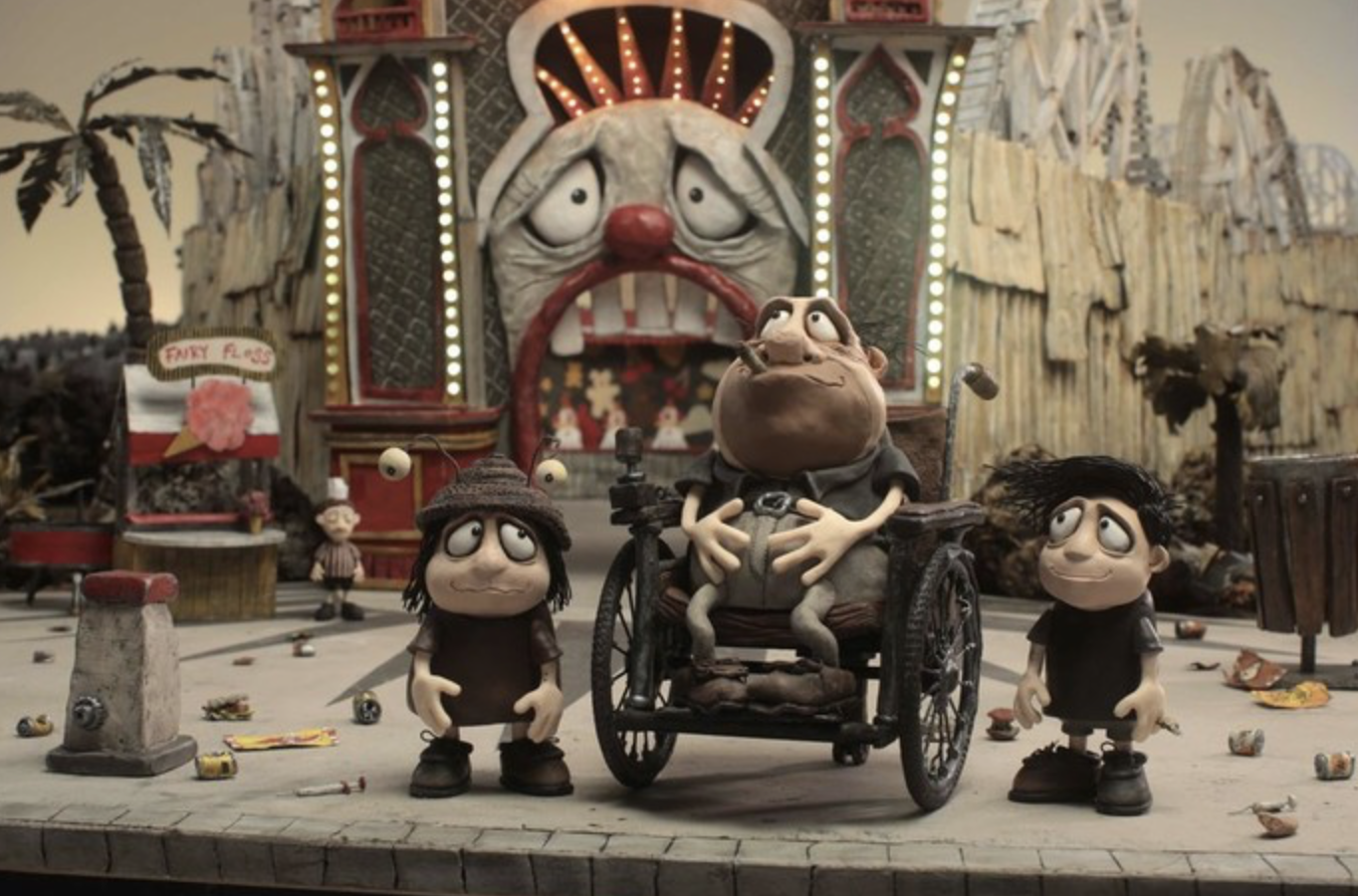
One of the latest international animated films to be released hails from Australia with writer-director Adam Elliot’s stop-motion tragicomedy, “Memoir of a Snail.”  With wonderful voice performances, a beautiful and poignant story, and visuals that bring Elliot’s ideas to full effect, this is an animated world in which you can lose yourself.

In 1970s Melbourne, Grace Pudel (Sarah Snook) and Gilbert Pudel (Kodi Smit-McPhee) are twins who are inseparable.  However, following the deaths of their parents, they’re sent to different foster families at opposite ends of the continent.  As the years go on and the hardships never seem to end, they’ll try to get by with the hope that they’ll see each other again.

Snook and McPhee have superb chemistry as siblings whose love for each other transcends the vast distances that are placed on them.  You can feel the everlasting bond in their voices as they miss each other more and more over the years.  There’s a sadness to both of them when they continue to lose time that they could’ve spent together, but there’s also a resilience within them as they face many challenges that threaten to crush their spirits, which gives them the strength they need to make their reunion possible.  There’s so much emotion and warmth that Snook and McPhee put into their performances, and the power that they give to their work in this film won’t leave you anything less than absorbed in their journey that shows how strong the connection between siblings can be.

While the film has several good supporting performances, the standout is Jacki Weaver as Pinky, a neighbor of Grace’s who befriends her.  Weaver exhibits a lot of wisdom in the voice that she gives her character, displaying someone who has been around the world and has seen it all.  Pinky is a joyful character throughout the film who’s always there to give Grace the help that she needs to make her day-to-day life more bearable.  Weaver instills Pinky with a personality that’s humorous and loving, giving the viewer a sense of reprieve from the difficulties that Grace encounters.

The screenplay by Elliot provides a dark, fanciful Roald Dahl-esque story that invests you in the characters and the unfortunate situation in which they find themselves.  It’s a narrative that’s imaginative, witty, heartbreaking, and uplifting, bringing audiences into a bittersweet fairy-tale that captures what it means to be a sibling.  As Elliot goes through the story, he tackles themes concerning the cages that are thrust upon us from outside forces vs. the ones that we set up ourselves, while also focusing on what it means to be hurt by the things that tend to give us comfort.  Through these themes, we get to learn the emotional depths of Grace and Gilbert, with Elliot instilling small, clever details throughout the film that emphasize the different aspects that go into their personalities.  Elliot creates engaging story threads for each of the two main characters, ensuring that both will keep you immersed in the poignant drama as the narrative brings you back and forth between the siblings.  While most of the film obviously unfolds after the death of Grace and Gilbert’s parents, Elliot offers plenty of insight into what their life was like beforehand, a life that was tough, but had a lot of love.  By showing this, we’re able to have a greater sense of the loss that they face once they become separated.

As a director, Elliot constructs beautifully strange visuals that transport you to the lives of the characters both before and after the inciting event.  While maintaining a tone that deftly mixes wit and heartache, Elliot highlights that blend of sensibilities to bring us imagery that dances between whimsical and dour, and the wonderful score from Elena Kats-Chernin helps emphasize the sense of wonder that’ll you experience during the movie.  There’s a richness in Elliot's animation that offers so much for us to look at and get a better understanding of his distinct vision of Australia.  The pain-staking detail that Elliot brings to the images matches what he brings to the film in terms of the screenplay, showing a filmmaker who does what he can to make sure the viewer is immersed in this journey from beginning to end.

Within a deep story about the power of the familial connections that sustain us, “Memoir of a Snail” captures what it means to be closed in, only then to finally break free.

Grade: A

Monday, November 11, 2024

A Love Story Between Two Classes

Mark Eydelshteyn and Mikey Madison in "Anora"
Photo Credit: Imdb.com
We’ve all seen stories like those, stories about two people who fall in love from different worlds, despite the restrictions that their social and economic stations have on them.  Given how long this type of narrative has existed, there’s a template that such stories follow, and we know where they’ll end up before the credits roll.  Despite the familiarity that we’ve come to expect, there are some cases where we’re not taken along the route that we expect, and this can make the story all the more impactful because of how much it tries to be more truthful to life.

Writer-director Sean Baker accomplishes this for his romantic comedy-drama, “Anora.”  It’s a love story unlike any that you’ve seen in a long time, one that washes over you with its zeal, laughs, emotion, and electric lead performance.

Anora (Mikey Madison) is an exotic dancer at an upscale Manhattan strip club.  When she meets the son of a Russian oligarch, Ivan (Mark Eydelshteyn), the two begin a relationship and get married soon after.  When Ivan’s parents threaten to travel from Russia to get the marriage annulled, Anora and Ivan face increasing complications that put their love in jeopardy.

Madison jolts the screen to life with her star-making performance that shows both her character’s strength and vulnerability.  There’s so much vigor to her character as she makes it through the rough patches of her day-to-day life, showing someone who seems to roll with the punches and try to keep her tough exterior intact.  Madison’s commitment to her character does excellent work in absorbing you in Anora’s life, offering a chance to get to know her as she steps into a life of luxury and then has to hold onto it and make that happiness last as long as possible.  Madison provides Anora with the type of streetwise grit where she’s not afraid to take control of a situation and stand up to those who get in her way.  This is a performance that comes with humor, joy, sadness, tension, and so much else, and Madison does whatever she can to make sure that you’ll remember her, whether it be in the heart-to-heart talks between her and Ivan or the chaotic highs into which she ventures later in the story.

The film comes with several performances from actors who may be unfamiliar to American audiences, but they leave an impact nonetheless in how much they inhabit their characters.  Eydelshteyn is terrific as a throws-his-money-around individual who never seems to grow up; Karren Karagulian is a lot of fun to watch as Toros, Ivan’s handler who tries to do his best to maintain the film’s increasingly messy situation; and Vache Tovmasyan and Yura Borisov as Garnick and Igor, respectively, Toros’ two henchmen, the latter of whom delivers one of the film’s most surprising performances in terms of where his arc goes.

All five of these performances coalesce incredibly well throughout the movie as everything unravels and they go further into disorder.  The way in which the cast members bounce off of each other to bring as much vivacity as possible to every scene is what makes this one of the finest casts of the year.  This is especially true in the movie’s tense, nearly-half-hour home-invasion scene where everyone gives whatever they can to the craziness of the sequence, all of which sets the unpredictable tone for the second hour of the film.

The screenplay from Baker takes a simple template and creates something invigorating, making a story that’s both a complex romance and a fast-paced thriller.  While most of the first half of the movie is a wonderful look at the main character and what could be her first real shot at love, it soon goes into a wild ride that takes you around New York City as Anora’s relationship meets one hurdle after another.  In the middle of the narrative’s kinetic location-hoping, we have a view of Anora and how other people see her, offering a depth to her character as she tries to have people see that she’s more than what they assume.   

With this movie’s NYC settings, as well as a segment that takes place in Las Vegas, Baker makes sure to capture their sights with cinematography by Drew Daniels.  Throughout the film, Daniels uses handheld camerawork to have us feel the energy that the characters experience, while also utilizing immersive long takes that allow for dialogues and emotions to unfold, a method that’s the most impactful in the movie’s final scene, which helps it become one of the best endings of the year.  Between Daniels’ photography and Baker’s screenplay and direction, the movie has the haywire energy of NYC-based movies, like Josh and Bennie Safdie’s “Uncut Gems” and “Good Time," with characters talking over each, being on the move for most of the time, and being followed by a dynamic camera that manages to keep up with the action.

It’s always exciting to see a filmmaker upend a certain type of story that has made its foundations through countless movies, and with what Baker does to the girl-meets-boy structure in “Anora,” you’re in for something that breaks those rules and creates a bold and exciting whirlwind of a romance.

Grade: A

Saturday, November 2, 2024

In the Vatican, an Election with Several Possible Outcomes

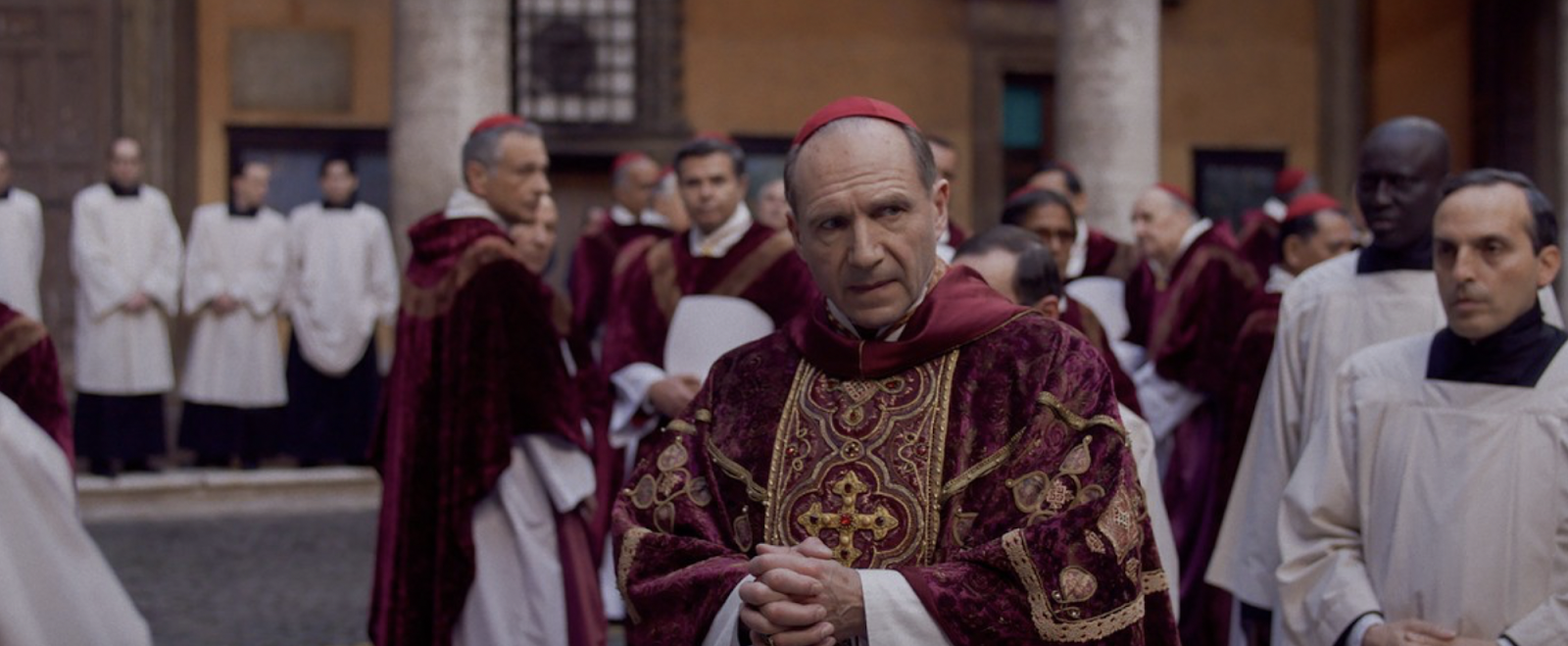
Ralph Fiennes in "Conclave"
Photo Credit: RottenTomatoes.com

In 2022, director Edward Berger delivered a harrowing war epic with his remake of “All Quiet on the Western Front.”  Using a sprawling scale of the battlefields and trenches to bring us the horrors of war, Berger visualized a story of the tensions and bloodshed of which men are capable under the most dire of circumstances.  It was an emotional and ambitious movie that had me looking forward to what Berger would bring us next.

With his latest film, Berger deals with tensions amongst men on a smaller scale, yet one that impacts the world, nonetheless, in his mystery-thriller, “Conclave,” which boasts a quiet, yet galvanizing lead performance, tense direction, and a story that’ll have you leaning forward at each twist and turn.

When the pope passes away, the Vatican is in a race to install a new leader for the Catholic Church.  Cardinal Thomas Lawrence (Ralph Fiennes) is put in charge to lead the conclave to choose the next pope.  As the election unfolds, he deals with candidates who want the position more than anything, as well as the secrets that some of them are hiding.

Fiennes delivers one of the best performances of his career as a man tasked with finding a leader.  He brings out his character’s sense of duty, but also shows the burden of having such an assignment.  Fiennes displays the gravity of what this task entails, presenting his character’s views of what such a decision means for both the church and the world.  This is a performance that thrives on how subdued it is, with Fiennes bringing forth a man of faith who’s also bothered by some questions that he has for the church that he serves.  His work in this film is superb throughout, but one of his most memorable scenes is one at the beginning of the voting process where he gives opening remarks about faith and uncertainty.  It’s a speech that captures his character’s viewpoints, all of which have complexities added to them when he doesn’t want the papacy himself, despite thinking that those best fit for power are those who don’t seek it.  It’s a fascinating depth that this role carries, and Fiennes is absolutely magnetic with how he grips your attention as you anticipate the decisions that Cardinal Lawrence will make.

Backing up Fiennes are some superb supporting performances from Stanley Tucci, John Lithgow, Sergio Castellitto, Lucien Msamati, and Carlos Diehz as cardinals who are in the running to be the next pope, and Isabella Rossellini as a Sister and the cardinal’s head housekeeper.  All of these cast members add their own bit of intrigue in the way that they approach their characters, having you wonder who’s hiding what secrets and what it’ll mean for the conclave as it commences.

The screenplay by Peter Straughan, which is based on the 2016 novel by Robert Harris, offers a tantalizing mystery that gets you hooked from the first scene.  From there, like all great film puzzles, it doles out details little by little as we become more wrapped up in the goings-on behind the Vatican’s walls.  The narrative is populated with characters who have their own goals for who they want to be in the church and what they want the church to be, and it’s never anything less than intriguing to see these clashes of views as the pool for the papacy successors becomes shallower.  All of this leads up to one of the most surprising conclusions I’ve seen in a movie recently.  “Conclave” is one of those occasions where I’m glad I didn’t read the book first because the last 10 minutes had the people at my screening murmuring in surprise with what it reveals, offering an electrifying experience of communal discovery that feels rare these days with theatrical releases.

Just as Berger did with the vast settings of “Western Front,” he’s able to bring us the fullest details of the more enclosed settings of the Vatican, giving off a strong sense of intrigue as we try to guess what’s going on within.  To accomplish this, he collaborates with cinematographer Stéphane Fontaine, who works on a level that he did with his work on Pablo Larraín’s 2016 film, “Jackie.”  Similar to how Fontaine gave us a look into the inner layers of the White House for that historical drama, he does the same with the Vatican in “Conclave.”  Fontaine not only has a talent for photographing places where people in high positions of power operate, but also when these places are in a period of transition.  With the pairing of Berger and Fontaine, they pull back the curtain on areas that many don’t get to see in real life, taking us through the courtyards, hallways, and private rooms of the Vatican.  Whether we’re in a scene with a character alone in a room finding out a secret, or a scene with many characters where there’s voting taking place, Berger maintains the thrills of the story no matter where he takes us on the Vatican grounds.  Helping to highlight these thrills is composer Volker Bertelmann, who worked with Berger on “Western Front,” and here, he provides music that emphasizes stringed instruments to maximum effect to have us feel the tightly-wound tension and weight of what’s happening around the characters.

“Conclave” is the type of fast-paced thriller that offers an equal abundance of suspense and narrative depth that cements this as one of the best films of the year.  While Cardinal Lawrence holds uncertainty as a virtue, you’re certain to be enthralled with this captivating mystery.

Grade: A